|
|
climberz
·
Aug 13, 2014
·
Unknown Hometown
· Joined Apr 2007
· Points: 95
I have had biners unclip about 5 times in 20 years, fortunately none resulting in anything other than the hairs on the back of my neck standing up.
1) At an anchor in j-tree sitting at the top of hemmingway buttress with 2 daisys, one in each of two bolts with unlocked, locking biners. Setting up rappel and I watched one biner flip over and unclip from the bolt. (Unrelated: now i never use daisies as they are the weakest piece of climbing gear.)
side note: I can't believe how many people i see say "off belay" while clipping one daisy into one of the two bolts and being good with that---bad idea!
2) Lowering down a sport climb in the RRG and having a standard quick draw that was unclipped when I got there. Don't know how it happened, did it come unclipped or did I not clip it (seems doubtful)?
3) Jugging/cleaning a pitch on the leaning tower. BD nano loaded weird and bent the gate around the tooth and gate was around the outside of the biner. This happened right after I unclipped the previous piece. It made a very loud popping sound when it happened.
4) Lowering down a sport pitch in boulder canyon I was passing a draw that unclipped. Not sure how it happened, but it did, right in front of me. (petzel spirit draw not some random offbrand).
5) Climbing elephant's perch, clipped into #4 camalot and went up placed next piece and pulled up rope and noticed rope was no longer in #4 camalot. Downclimbed and clipped it back in. Unclipped by biner opening on rock?, only partially clipped?, kicked it??
6) Also had locking biners unlock MANY times. Belaying follower, look down, belay biner unlocked, I screwed it shut again. Later in same pitch belay biner unlocked again and redirect biner unlocked also.
Now i use a Petzel two move locking biner (don't know the name), its hard to use but i am used to it now. I also use the DMM that has the plastic bar to keep the biner from crossloading (on other biners i've caught countless falls and looked down to see the biner crossloaded) This crossbar on the biner also keeps it from unlocking. I use this on my gri-gri.
Consequently:
I always want to be 2 GOOD pieces and 2 good biners and 2 good slings off a fall I cannot afford to take. It is scary that 2 pieces failed in this recent accident and I know that this individual KNOWS what the hell he is doing, which makes this especially scary for me and I'm sure all posting here. (best wishes and hope you heal soon)
I followed the lead of a friend and very good climber in having a couple locking draws on my rack, both top and bottom biners. Obviously putting one on every piece is impractical, but I try to put them in strategic locations, such as at the crux, at the 3rd bolt (thinking that I am high enough to die, and not protected from one bolt unclipping by another one below me, such as high on the route. Also after, or before a runout, or when only one piece is between me and the ground.
Obviously this is not foolproof, but I try hard to eliminate chance from playing out.
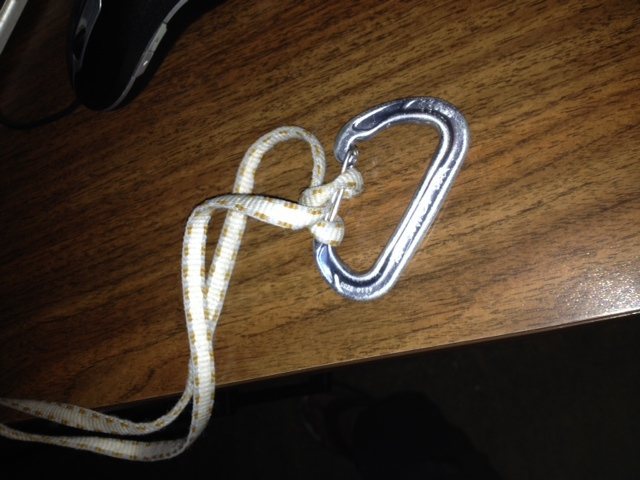
Also, I have clove hitched many biners before and a serious problem exists. If the knot is not VERY tight a loop of the clovehitch can and does (i've seen it) go around the bottom of the gate, holding gate of the biner wide open.
Two good pieces, two slings, and two biners is best. A locking biner is good, but it's still only one piece in the chain.
I have climbed with many people over the years. The good and experienced ones do it the same. Two pieces at the crux, and two after and before runouts.
Hopefully this will work for me. Best wish to Wayne....heal up...many are thinking of you.
0
|
|
|
Fat Dad
·
Aug 13, 2014
·
Los Angeles, CA
· Joined Nov 2007
· Points: 60
bearbreeder,
Knotting dyneema slings has a significant impact on their strength. Though the following link shows testing only for an overhand knot, I can't foresee why the results with a clove would be that different. Regardless, the results are pretty sobering: dmmclimbing.com/knowledge/h…
Every climber should be aware of this issue. Be safe out there.
|
|
|
David Appelhans
·
Aug 13, 2014
·
Broomfield, CO
· Joined Nov 2007
· Points: 410
Does anyone know the specific biners that were involved in the accident? If the failure mode is correct, it is basically the biner turning perpendicular to the sling, and I would imagine the chance of this happening is very much related to the shape of the biner.
This is not the first accident I know of where a climber decked after the top piece caught part of the fall and then failed. When the top piece tensions the rope and then a fall occurs it whips the lower pro around and can lead to pieces unclipping. I saw it happen in Indian Creek where the top piece blew out of the rock and several pieces below that should have caught the climber were in the crack with biners attached and no longer attached to the rope.
How about climbing with double ropes? Then only the gear attached to the top rope would get yanked all around when the top piece tries to catch the fall.
|
|
|
Stagg54 Taggart
·
Aug 13, 2014
·
Unknown Hometown
· Joined Dec 2006
· Points: 10
David Appelhans wrote:How about climbing with double ropes? Then only the gear attached to the top rope would get yanked all around when the top piece tries to catch the fall. In my experience falling on doubles generally results in tension on both ropes (unless you run it out a lot or are intentionally only clipping 1 rope). With the extra stretch in the ropes, you usually fall past whatever your second piece is and usually that is clipped to the other rope.
I would think both ropes would get yanked around a bit.
|
|
|
Kris Holub
·
Aug 13, 2014
·
Boulder, Colorado
· Joined Jan 2011
· Points: 70
Does anyone know where the biner attached to the second piece ended up? If the proposed failure mechanism occured, the biner should be attached to the rope on the belayer side of the blown stopper/screamer. If the biner is still hanging on the long sling, then that would suggest either the rope was never clipped in or walked out somehow.
|
|
|
William P.
·
Aug 13, 2014
·
Unknown Hometown
· Joined Jan 2013
· Points: 0
Antonio wrote:
All that video really shows is that you should always inspect your gear before you leave the ground, which should be done regardless of whether you have a rubber band on the end of a sling or not.
+1
Rubber bands work fine for extended draws and eliminate the dreaded knot (sarcasm). Just check before leaving the ground, kinda like checking your knot.
|
|
|
Keith Boone
·
Aug 13, 2014
·
Henderson, NV
· Joined Jul 2013
· Points: 497
This accident has me thinking about my setup.....
1. I have several solid gate biners that could be replaced by wire gates to stop potential gate flutter.
2. I typically use 24" runners when trad climbing. Maybe these should be replaced with long draws and only carry a few slings.
3. I used screw gate biners, these should be replaced with double locking biners.
Aside from money, do these changes seem to address the items of concern and improve safety? Any flaws in this setup?
|
|
|
Scott McMahon
·
Aug 13, 2014
·
Boulder, CO
· Joined Feb 2006
· Points: 1,425
Keithb00ne wrote:2. I typically use 24" runners when trad climbing. Maybe these should be replaced with long draws and only carry a few slings. Just using draws wouldn't work in alot of situations unless the route is a near direct line. Rope drag would be insane.
|
|
|
Keith Boone
·
Aug 13, 2014
·
Henderson, NV
· Joined Jul 2013
· Points: 497
Scott McMahon wrote: Just using draws wouldn't work in alot of situations unless the route is a near direct line. Rope drag would be insane. How would a 24" sling be any different than a 24" draw?
|
|
|
The Blueprint Part Dank
·
Aug 13, 2014
·
FEMA Region VIII
· Joined Jun 2013
· Points: 460
Keithb00ne wrote: How would a 24" sling be any different than a 24" draw? There aren't too many great ways to keep two feet worth of quick draw from getting in your way as you climb for one...
|
|
|
The Blueprint Part Dank
·
Aug 13, 2014
·
FEMA Region VIII
· Joined Jun 2013
· Points: 460
Also, Eli dude bro had some funny posts. He sprays about doubling the number of bolts on a pre-existing sport route and how it "might change the character" of the route. Haha this guy is an awesome troll. Or a dumb ass. But I think troll, a very very good troll.
Kudos my man
|
|
|
Nkane 1
·
Aug 13, 2014
·
East Bay, CA
· Joined Jun 2013
· Points: 475
William P. wrote:Antonio wrote: All that video really shows is that you should always inspect your gear before you leave the ground, which should be done regardless of whether you have a rubber band on the end of a sling or not. +1 Rubber bands work fine for extended draws and eliminate the dreaded knot (sarcasm). Just check before leaving the ground, kinda like checking your knot. I respectfully disagree.
The rubber band thing is a real problem, one that has killed at least two people that I'm aware of.
Personally, I don't need more things to check when I leave the ground (at at each belay), especially when one of those things is a well-known but easy-to-miss failure mode that can and has killed.
And if you think that a tripled sling can't clip itself into the dangerous configuration while on your harness or while cruxing out, then I gently submit that you haven't trad climbed long enough.
Regarding the Eldo accident, I'm also curious about the type of biner that was involved. Is this kind of unclipping more or less common with wiregates, bent-gates, or solid gates?
Personally, I can't tell if this is kind of risk that I should be taking really seriously, to the point of clove-hitching my extendable draws or introducing lockers into my systems, neither of which I've ever done, or if this is a one-in-a-million thing that is only possible when an upper piece blows.
The way I see it, this failure mode is a risk when (1) you are climbing above a sketchy piece (2) on terrain that presents a real risk of falling, and (3) the piece below the sketchy piece is clipped with an extended trad draw. Are there other situations where we're concerned about this? Has this ever been shown to happen when the extended draw is the top piece?
If this only happens when the upper piece blows, then isn't the solution to place better gear? Or to not use an extended draw as the last piece below a section with dicey gear? I'm not familiar with the climb in Eldo and whether that was an option, but recall that the climber had clipped it with a screamer, indicating he didn't trust the piece. Is it possible to double up the gear there? What if he had clipped the second-to-last piece, the one that came unclipped, with a regular draw rather than an extended one? Would rope drag have been prohibitive?
Are there solutions to this problem other than completely re-thinking the idea of extendable trad draws, which have been in standard usage for decades?
If the risk is only present in the situation I've outlined, then I like the idea of clipping an extra free biner (maybe the cam biner, if you rack your cams on single biners, as I do) to the rope end. You're not likely to face this situation frequently, and this avoids the need to completely change your racking strategy.
But if this is a significant risk that's present in more situations, then maybe I need to rethink things more.
|
|
|
David Appelhans
·
Aug 13, 2014
·
Broomfield, CO
· Joined Nov 2007
· Points: 410
Stagg54 wrote: In my experience falling on doubles generally results in tension on both ropes (unless you run it out a lot or are intentionally only clipping 1 rope). With the extra stretch in the ropes, you usually fall past whatever your second piece is and usually that is clipped to the other rope. I would think both ropes would get yanked around a bit. I haven't experience much tension in the second rope. If gear is about 8 ft apart, and you fall about 3 feet above your last piece, you will fall 6 ft before your top rope starts to catch you. When you fell you would have had 11 ft of rope out from the second piece on the second rope, and that rope wouldn't come tight until you had fallen 22 ft.
If you put two pieces fairly close to each other (like 3 vertical feet apart), then I agree they will both be tight, but then both pieces have to fail for you to be worried about the tension whipping and unclipping lower pieces.
|
|
|
runout
·
Aug 13, 2014
·
Unknown Hometown
· Joined Jun 2013
· Points: 30
David Appelhans wrote: I haven't experience much tension in the second rope. If gear is about 8 ft apart, and you fall about 3 feet above your last piece, you will fall 6 ft before your top rope starts to catch you. When you fell you would have had 11 ft of rope out from the second piece on the second rope, and that rope wouldn't come tight until you had fallen 22 ft. If you put two pieces fairly close to each other (like 3 vertical feet apart), then I agree they will both be tight, but then both pieces have to fail for you to be worried about the tension whipping and unclipping lower pieces. Skinny ropes aren't as durable as a fat one and is one of the reasons preventing me from using them full time - I would replace them way too often from abrasion and falls. Seems very costly. But then if that's the price to pay for better safety then it might be worth it.
|
|
|
Greg D
·
Aug 13, 2014
·
Here
· Joined Apr 2006
· Points: 908
climberz summed it up well.
And as usual, IT DEPENDS.
Biners do unclip themselves in many scenarios as he mentioned. I have seen a leader, 40 feet up, lots of gear in place, lead fall, and the first piece close to the ground rip out (beginning of zipper affect), unclip itself form the rope and fly over the belayer head landing forty feet away. The point being, when a leader falls and the top piece begins to get loaded, the rope and all gear below may be subject to an instantaneous and violent whip. Cams can rotate, nuts pop, biners get whip lash, etc. If the top piece holds the load briefly, the situation may be worse than if it just popped without holding any load.
In the accident in question, there appears to have been a leader fall with enough (but very brief) load on the top piece to cause a few bar tacks on the screamer to pull. This is when rope whip likely occurred. The biner on the piece below got whipped by the rope and may have unclipped at this time. The mode suggested by Stephan is plausible, but less likely imo since the biner would have to be in the perfect plane with the sling in the perfect place on the biner gate and the rope loading at fairly precise angle. Still possible though.
I don't think a clove hitch is a good solution. Sounds like a pita to begin with. But my slings often get used for multiple purposes and a fixed biner may need to be removed for a given situation. More importantly. cloves are quite good at unclipping biners which is why lockers are recommended with cloves. Without regularly dressing and cinching an additional mode of inadvertently unclipping biners is introduced. Also, knotting dyneema is not the best situation where it will be subject to a lead fall. It really is not that hard to impart 10kN to your top piece in a lead fall, such as the accident in question which may have been a fairly high impact had the second piece not unclip. Knotted dyneema loses 40 to 70% of its strength depending on what website you read. So at only 7 to 12kN the dyneema may fail before your gear breaks. Yes most gear is rated to only 10kN. But I would put money on a knotted dyneema sling failing before most medium and large nuts and cams.
Conclusion. It depends. A locker may be the best way to prevent both gate flutter failure and Stephan's mode. Should you put a locker on every sling or draw? Not necessarily. Consider how important that piece is if you fall. Reread climberz' s advice ( let's get out soon Zack) and remember tony bubbs mantra, always keep at least two pieces between you and the hospital.
|
|
|
runout
·
Aug 13, 2014
·
Unknown Hometown
· Joined Jun 2013
· Points: 30
|
|
|
Matt N
·
Aug 13, 2014
·
CA
· Joined Oct 2010
· Points: 476
1 shit happens
2 climbing can be dangerous
use this knowledge appropriately
|
|
|
Stagg54 Taggart
·
Aug 13, 2014
·
Unknown Hometown
· Joined Dec 2006
· Points: 10
David Appelhans wrote: I haven't experience much tension in the second rope. If gear is about 8 ft apart, and you fall about 3 feet above your last piece, you will fall 6 ft before your top rope starts to catch you. When you fell you would have had 11 ft of rope out from the second piece on the second rope, and that rope wouldn't come tight until you had fallen 22 ft. If you put two pieces fairly close to each other (like 3 vertical feet apart), then I agree they will both be tight, but then both pieces have to fail for you to be worried about the tension whipping and unclipping lower pieces. Maybe I'm a wimp and just like to sew it up. That and I like to place a piece for both ropes right before the crux if I can - that whole redundancy thing...
Keep in mind too though that double ropes stretch a lot!!! so high on a long pitch it's a definite possibility.
This double rope has 11.5% static elongation and 36% dynamic elongation...
wildernessexchangeunlimited…;PID=5380
If you are 150 feet out - 10% is 15 ft...
There's not always tension on the other rope, but it does seem to happen fairly often for me (when I do happen to fall).
|
|
|
bearbreeder
·
Aug 13, 2014
·
Unknown Hometown
· Joined Mar 2009
· Points: 3,065
folks a few replies
heres a list of some ways ...
tape method (not recommended unless you and yr partner can recognize the failure mode)
edit ... ive thought about it abit and while im fine personally taping up the sling and using it myself, if someone else uses your gear they might not recognize this kind of loading ... im not recommending the tape method
- put a the stitching right against the rope end biner, and wrap a length of tape until its at least the length of the biner
- see the failure mode below
- full strength
- bottom biner is now fixed until you take off the tape, cant do/undo on the move
- doesnt twist the sling
- you should take off the tape to inspect below every now and then
edit to add ....
clove hitch method - 65-75% strength on 8mm dyneema (DAV and mammut tests)
- you can do/undo in real time (no tape, fairly easy to tie/untie)
- need to make sure its tight and loaded against the spine to prevent the hitch from moving as i mentioned prior ... with skinny dyneema slings IMO the risk is not that great, lockers are usually recommended for clove hitching rope which are thicker and stiffer
- can impart a slight twist on the sling
girth hitch - reduces strength ~50%
- you can do/undo in real time (no tape, fairly easy to tie/untie)
- same as the clove, you need to make sure its tight and loaded against the spine
- doesnt twist the sling
overhand knot
- reduces strength ~50%
- harder can do/undo in real time, its basically fixed
- not as much worry about coming out such as with the clove/girth
- you can use an elastic safely
- doesnt twist the sling
locker
- full strength
- prevent the rope from coming out as well
- heavier
- fiddly
rabbit runner, long draw, snake cord
- from 65% (homemade) -100% strength
- cheap (homemade) to more expensive
- less flexibity in terms of slinging features
second opposed biner (not shown)
- full strength
- prevent the rope from coming out as well and redundant for biner breakage
- heavier
- fiddly
- for cams you may be able to use the racking biner that may just be sitting there anyways
as to the forces involved
personally im pretty confident with the clove on newish slings (less than 2-3 years) in good condition as long as there is rope in the system ... even the overhand and girth hitch im not overly worried
as can be show below on 8mm dyneema slings a clove loaded as a loop reduces the strength by around 25-35% .. which still allows 14-16 KN ... plenty IMO
remember that even in a UIAA 1.77 factor fall with a 80 kg steel drop weight most commercial climbing ropes see < 10 KN (12 KN limit) of impact force ... (edit: force on top piece will be higher due to pulley effect)
now use squishy flesh, real life stretch of the harness, slip of the belay device, etc ... and im not overly worried especially for cragging with much lower fall factors
for multi if yr worried, then use a normal draw or two for your first piece ... i would be worried about the carabiner nose hooking, the rope coming out from the biner, etc ... and other such scenarios
as to the "frequency" of such happening ... its not something i worry about greatly ...
- on lower angle climbs its probably more likely as the sling can bunch up and the biner stuck/hit features
- with vertical cracks the biner can hit the sides of the crack and open up or get loaded badly (this ive seen a decent amount) ... in this case having the rope or sling unclip is much more likely .. not to mention despite our best efforts we sometimes step on the sling/biner on vertical cracks
- with skinnier slings its probably more likely as thicker slings have more surface area that is wider relative to the gate opening, which helps prevent it IMO
personally i
- carry 2 120 cm slings with lockers at both ends for "no fail" placements
- carry my 60 cm slings normally ... if it looks like the sling might bunch up or the biner rotate, i throw in a clove if its a very good stance
- if its not a good stance or i want additional security, i throw in the racking biner from the cam opposed
- it its an "absolutely no fail" placement ill put in a second opposed draw/sling for full redundancy
lastly remember that the sling can also come out from the pro side .. the only way to really prevent this is lockers on both ends or a second opposed draw, which i use for critical placements
ultimately you need to make that decision or risk vs. weight/fiddle factor yourself
YMMV
|
|
|
reboot
·
Aug 13, 2014
·
.
· Joined Jul 2006
· Points: 125
bearbreeder wrote:remember that even in a UIAA 1.77 factor fall with a 80 kg steel drop weight most commercial climbing ropes see < 10 KN (12 KN limit) of impact force ... That's the impact force of the climber, not the sling/pro, which is much higher (not quite double). Still, 14KN is higher than the rating of most smallish pro. But add in some wear & tear, the margin isn't terribly large anymore.
|

 Continue with onX Maps
 Sign in with Facebook