|
|
paulraphael
·
Feb 6, 2011
·
Unknown Hometown
· Joined May 2007
· Points: 0
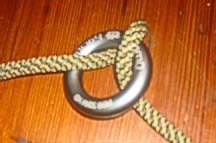
Tom Grummon wrote:I like the idea of the ACR, and can't really think of a reason not to have a rap ring on your cordelette; other than the wraps around the ring potentially weakening the chord, but that seems negligible (maybe? Spectra may weaken, nylon may not). With the ring you can still do the equalette and cordelette methods as well as the ACR. The knot will weaken the cord more and will always be where the cord breaks.
|
|
|
paulraphael
·
Feb 6, 2011
·
Unknown Hometown
· Joined May 2007
· Points: 0
Glenn Gordon wrote:The PDF shows a not recommended way of connecting upward directionals. Are there any updates on how to connect them? -Glenn Some people are using a separate sling clipped directly to the ring, or to the belayer's harness.
I'd like to find a more elegant solution. The idea crossed out on the PDF looked good on paper but was a mess in practice.
|
|
|
Scott Bower
·
Feb 6, 2011
·
Fort Collins, CO
· Joined May 2003
· Points: 25
I do it sometimes, but Building an anchor with the rope has some disadvantages.
Not swapping leads is difficult.
Adjusting belayer position is difficult.
Uses extra rope that may be needed on next pitch.
Doesn't work for short fixing.
But the biggest disadvantage is that it limits options for self rescue if the other climber has an issue.
|
|
|
Vincent Penoso
·
Feb 6, 2011
·
Alexandria, VA
· Joined Jul 2008
· Points: 35
Ever since i saw the ACR maybe 5 years ago i have used it for its simplicity and quick set up. I used the ACR when I could with 2 downward pull pieces and one for the upward pull. (Thanks Paul)
Almost immediately I began using a variant to this cordalette by adding an additional loop to the ring that I have referred to as the VV (vince variation ACR-VV); I have always used it in this configuration now since '06??? It is set up in the exact same manner as the "ACR" but then you are left with the option of another loop for the upward pull
I did use the omega pacific rings but went back to using the thinner diameter rings to reduce the friction for quicker equalization in case the unthinkable ever happened.
I carry (2) ACR-VV when I lead, one I leave for my follower and the other for my next stance. With 3+1 pieces (3 downward and 1 for the upward pull), I can create a bomber srene "web" anchor; but I foresee it will extend a little as it equalizes should a piece blow.
The ACR, in whatever configuration you choose is versatile. I can use it with 3 or 4 pieces of pro or as I would a regular cordalette for anchors, slinging trees or hanging elk (just kidding). The ring on the cordalette is never of any consequence ( beiner wrap ) except for getting in the way before you slide it out of the way, but you see the same thing when the knot gets in the way anyway. I bring the ACR when climbing ice and I don't need a special cordalette.
I sense a mountain of skepticism about the ACR from what appears to be people who have never even tried using it. HEY-try it out for yourself-spring for $3 rap ring. It is a wonderful tool for anchors and i think you'll become a believer if of course you lead.
I have used this for a long time and I am not encouraging or endorsing its use to anyone and the description here is purely for entertainment and self enrichment purposes ONLY; Use at your own Risk; YMMV!
|
|
|
Vincent Penoso
·
Feb 6, 2011
·
Alexandria, VA
· Joined Jul 2008
· Points: 35
Tom Grummon wrote:I like the idea of the ACR, and can't really think of a reason not to have a rap ring on your cordelette; other than the wraps around the ring potentially weakening the chord, but that seems negligible (maybe? Spectra may weaken, nylon may not). With the ring you can still do the equalette and cordelette methods as well as the ACR. I have used a guide trick I learned in the White Mountains of NH called a beiner wrap where you take up the slack in the rope, webbing or cord with a few turns around a beiner; same thing here; no effect on the static use of the acr.
|
|
|
Vincent Penoso
·
Feb 6, 2011
·
Alexandria, VA
· Joined Jul 2008
· Points: 35
Justin Baker wrote:What are you thoughts on the ACR Anchor Method: The Alpine Cock Ring Seems kinda cool, but also kidna gimmicky. One concern is clipping a biner to the rap ring. I have always been told biner to biner is bad practice, so is this the same kind of thing? I dunno about the beiner to beiner myth.
I have heard this for YEARS and I don't think there is any truth whatsoever to this, afterall, You do and have clipped quick draws into a metal petzl or metolius hanger in ones experience while climbing -YES!!!!!!!!!!!! ? OR CLIP YOUR ATC-GUIDE TO A beiner. i have never read any warnings.
What are your thoughts?
|
|
|
Portwood
·
Feb 6, 2011
·
Your moms house last night
· Joined Sep 2010
· Points: 45
Mike wrote:People probably hate to see posts like this in threads like these, but... Why not just anchor with the rope instead of bringing all the extra thingamajigs along? You are already tied in to a super-strong, super-dynamic cord. Just use it. only efficiently works if your are swapping leads, that’s why...
|
|
|
Unboundquark
·
Feb 7, 2011
·
Unknown Hometown
· Joined May 2008
· Points: 195
vincent penoso wrote: Ever since i saw the ACR maybe 5 years ago i have used it for its simplicity and quick set up. I used the ACR when I could with 2 downward pull pieces and one for the upward pull. (Thanks Paul) Almost immediately I began using a variant to this cordalette by adding an additional loop to the ring that I have referred to as the VV (vince variation ACR-VV); I have always used it in this configuration now since '06??? It is set up in the exact same manner as the "ACR" but then you are left with the option of another loop for the upward pull Could that additional loop around the ring then be used for either an upward pull OR a fourth downward pull piece?
-Glenn
|
|
|
Vincent Penoso
·
Feb 7, 2011
·
Alexandria, VA
· Joined Jul 2008
· Points: 35
Glenn Gordon wrote: Could that additional loop around the ring then be used for either an upward pull OR a fourth downward pull piece? -Glenn You can use it for whatever you want (read my posts above). The reason I made this modification to the ACR is to have 3 downward bomber pieces and one for the upward pull or if you really had bad pro and needed 4 downward pieces I'd be sketched and just hang myself with the extra loop..... lol
|
|
|
paulraphael
·
Feb 7, 2011
·
Unknown Hometown
· Joined May 2007
· Points: 0
I'm curious about this idea. I'd suggest testing the bejeezus out of it in the garage before taking it into the hills.
Watch especially closely for any binding, or for the thing twisting into unpredictable shapes when using an upward directional.
And please post your impressions.
|
|
|
Buff Johnson
·
Feb 7, 2011
·
Unknown Hometown
· Joined Dec 2005
· Points: 1,145
I'm not too keen about having the upward using the same cord as the multi-point anchor. I'd rather just put the upward on the belayer's harness and keep the ACR as a separate rig.
|
|
|
paulraphael
·
Feb 7, 2011
·
Unknown Hometown
· Joined May 2007
· Points: 0
Mark Nelson wrote:I'm not too keen about having the upward using the same cord as the multi-point anchor. I'd rather just put the upward on the belayer's harness and keep the ACR as a separate rig. That's my inclination too, but I haven't experimented with this idea.
|
|
|
Mike
·
Feb 7, 2011
·
Phoenix
· Joined May 2006
· Points: 2,615
Portwood wrote: only efficiently works if your are swapping leads, that’s why... Really? It works great for me. I must be doing something wrong.
It works only adequately for building super complex anchors when leading every pitch. However it works great for simple anchors when leading every pitch/leading in blocks, and most anchors are simple. This is getting more prevalent every day, as bolted belays seem to be the norm, even on older climbs that were not put up that way. When climbing some remote adventure MP route it can of course be prudent to bring some type of extra cord/webbing along for several reasons.
Also from up-thread, IMHO adjusting belayer position is easiest when using the rope to anchor. You can simply clip in anywhere and/or move around & change position on the fly with only a carabiner. Quick, simple, efficient & safe.
Self rescue is a little different but not bad. Practice it a bit & see.
It does use up more rope though.
Just my opinion.
|
|
|
Vincent Penoso
·
Feb 7, 2011
·
Alexandria, VA
· Joined Jul 2008
· Points: 35
paulraphael wrote:I'm curious about this idea. I'd suggest testing the bejeezus out of it in the garage before taking it into the hills. Watch especially closely for any binding, or for the thing twisting into unpredictable shapes when using an upward directional. And please post your impressions. Hi Paul.
I thought I'd take you up on the offer to post this ACR-VV here, but a lot of this discussion is academic because I have been using this rig as is since the first time i contacted you at least 4 years ago.
John Long talked about minimum number of pieces for a bomber belay and in the end he would always say , "and don't forget one for the upward pull." I liked the ACR when I first found it on line, but I have always built anchors with at least 3 but usually 4 pieces-including the one for the upward pull under ideal stances. Sometimes this isn't possible.
The ACR-VV affords me this option of 4 total. I don't know if there is anything i can add to this discussion since it is what I use and i like how it works; "you can hang a truck off that anchor", Bob Barribeau, IMCS Guide comment on my anchor using the ACR-VV during an ice leading clinic, Frankenstein Cliffs 2008; Bobs delight. I had an abalakov and 3 screws on a ridiculously bomber anchor I built for demonstration purposes only. Anyway, glad I could share this. Take care everyone!
|
|
|
paulraphael
·
Feb 8, 2011
·
Unknown Hometown
· Joined May 2007
· Points: 0
vincent penoso wrote:...a lot of this discussion is academic because I have been using this rig as is since the first time i contacted you at least 4 years ago.... Vincent, I'm happy that you contributed your ideas and experience. It's still important to consider the difference between using an anchor and testing it. Most people's belay anchor techniques never get tested, because falls onto the anchor are so rare.
Some kind of simulated testing is necessary. When it comes to testing upward directionals, things get much more complicated because you're adding so many variables to the mix.
There are many ways to imagine the cord binding and getting twisted up in this situation with your variation. It's also easy to imagine the ring simply getting pulled straight up as all the slack in the upward strands pulls through it (in other words, there being much too much extension possible on the directional strands).
And there are unforseen complications that could show up in drop tests in the garage.
I'm not trying to be a buzzkill; I just don't want anyone to think that just because someone's used this variation that it's been tested. The value of a forum like this is that other people can examine new ideas for weaknesses. I'd like to see your variation go under more scrutiny before people start using it as a safety net.
|
|
|
Tom Grummon
·
Feb 9, 2011
·
Salt Lake City, UT
· Joined Oct 2009
· Points: 30
I don't like the idea of putting the upward directional in the rig because of the equalization:
Say I have some nuts in that will pop with upward force. As an upward force is applied to the ACR it will automatically equalize and put some of that force on the nuts, thus popping them and extending/ shock loading the anchor.
Not tested, just hypothetical.
|
|
|
Buff Johnson
·
Feb 9, 2011
·
Unknown Hometown
· Joined Dec 2005
· Points: 1,145
I don't really see that to be any more a concern than any other rig that uses passive gear.
What this rig does is maintain load distribution over a range of direction; I can only offer anchor building is not an application of redundancy or attempting perfect equalization, it's more about effectively distributing a load off of solid protection. If you load this or any other passive anchor in a direction not intended, you'll just pop the pro out, which is why putting some active gear helps, along with that upward.
What is probably more the concern would be wide angles introduced if you used the same cord for the anchor and the upward; so rig the upward separately.
|
|
|
Vincent Penoso
·
Feb 9, 2011
·
Alexandria, VA
· Joined Jul 2008
· Points: 35
Mark Nelson wrote:I don't really see that to be any more a concern than any other rig that uses passive gear. What this rig does is maintain load distribution over a range of direction; I can only offer anchor building is not an application of redundancy, it's more about effectively distributing a load off of solid protection. If you load this or any other passive anchor in a direction not intended, you'll just pop the pro out, which is why putting some active gear helps, along with that upward. What is probably more the concern would be wide angles introduced if you used the same cord for the anchor and the upward; so rig the upward separately. Good Point Mark.
I dunno why I called it an upward although, relatively it is located there.
I want to call the ACR-VV a multi-directional anchor that distributes the load over an area.
Analogy: If you allow the fingertips of your hand to come in contact with a surface ( THING-Addams Family ) the ACR-VV forms a web with a multidirectional master point. Forget the talk about upward pull- it is a multidirection web with a master point.
|
|
|
Steven G
·
Mar 13, 2011
·
Unknown Hometown
· Joined Mar 2011
· Points: 5
Great Thread
I've been using a similar system for a lot of years (as most on this board have.) I learned it from an Inyo County Sheriff deputy that was gonzo into ice climbing. He used very long ones made of webbing to equalize the load on two or more ice or hard snow bollards (bomb proof). The only thing I don't like about the ACR that was shown in the thread opener is shortening the active element. If a placement is too close or too far its an easy thing to shorten the runner to the protection instead of the equalizer itself and get everything cinched down and under control. And of course as has been mentioned a directional is mandatory. Then of course to prevent that fall past the belay I'll do what you all probably do and put in a few double placements on the way to the next stance that are likewise equalized.
The one shown in the picture is $40.00. I wont pay that so I make my own with since by some stroke of dumb luck I fell into the possession of a power sewing machine that had been used for making big military tents. for webbing versions I use Blue Water 1" and 9/16-inch Climb-Spec tubular webbing and Kevlar thread)and 9mm static for the rope variety.
Strength Issue:
1" inch tubular has the same 19kN breaking strength as 9mm static line the chubby 9/16" Blue Water tubular is listed as having a 2300 pound break force(10kN). The Trango Alpine equalizer claims a 25kn breaking strength anyone know where to get a spool of the webbing they use?
Note:for belays I use the 9mm and 1 inch webbing versions, the 9/16 stuff is used to equalize protection placements above the belay.
|
|
|
S.Stelli
·
Mar 22, 2011
·
Colorado Springs, CO
· Joined Dec 2009
· Points: 150
I'm just a dumb newb, but I thought I would pose the question for the smart and/or experienced folks.
Has anyone tried this method (exactly as Paul has laid out), but instead of using a rap ring for the powerpoint, a figure 8 rap device?
The BD 8 is rated to 15kN - so 3375lbs roughly?
If you used the large hole on the 8 for the power point, several more biners could be clipped in if needed. You could also position the small hole downward for a seperately rigged, upward pull piece of pro.
The downsides of course are the possibly tripled weight over the rap ring and size of it, and it would be harder to keep the 8 out of the way if the rig was used in "non-ACR" ways like a cordalette, sliding-x....
Also, the rap ring is rated quite a bit higher than the Figure 8 device. Would the difference between 15kN and 20kN be that great, when you consider the figure 8 would also be wrapped with the cord like the rap ring is and distributing some of the load?
One last question, totally seperate from the above - has anyone tried this ACR with a rap ring like this: SMC Rap Ring
This ring does not have a round radius, but it IS rated to 32kN. Looks like the sliding friction on this ring would be different than a round ring for sure.
|

 Continue with onX Maps
 Sign in with Facebook