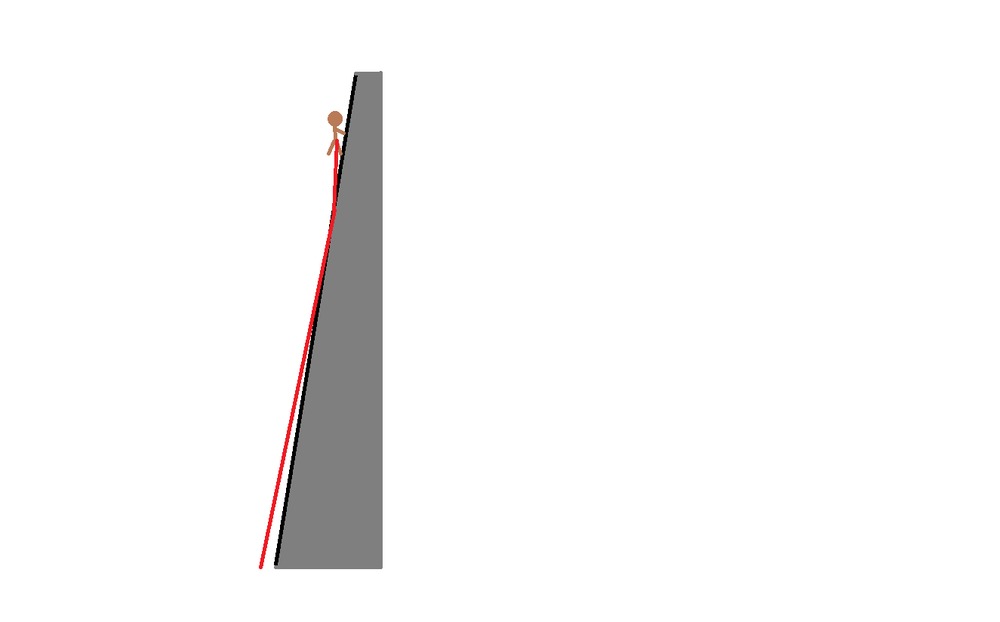
Dave K wrote How could this climber on a slab possibly get "spiked" into the wall?
I have inadvertently done it. Lightweight climber (~100lbs), heavier belayer (~160lbs). Climber was approximately .5m above the bolt, with about 10m of rope in service. Granite slab climb, just less than vertical with a short crux of almost vertical terrain. Climber fell and I gave an unintentional hard catch. The climber fell out slightly from the wall then the rope came tight and she accelerated into the wall and twisted her ankle.
The issue in this anecdotal situation seemed to be that her downward velocity was translated rapidly to horizontal velocity due to a very short fall with a small amount of rope in service. If I had jumped or let out a very small amount of slack (which I have done hundreds of times before and since) the fall would have not accelerated the climber into the wall.
If you are moving outwards, something needs to push. What is this mysterious force that causes some climbers to fall horizontally outwards?
My impression is that the "mysterious force" you are asking about depends on the mechanics of falling. If your hand pops off and your feet stay on, you will tilt back slightly as you fall.
On the other hand, my partner whipped at Lumpy this week. His foot slipped and he fell straight down, almost scraping the wall with his right hip. The mechanics were different.
csproul
·
Jun 29, 2020
·
Pittsboro...sort of, NC
· Joined Dec 2009
· Points: 330
Dave K wrote:
Only our hands and feet are in contact with the wall. Our center of gravity (basically our hips) is always away from the rock (at most by about the length of our arms which can be about two feet, but rarely does one fall just as their arms are completely extended horizontally.) On a plumb vertical wall our center of gravity is typically about a foot from the wall.
When we fall our center of gravity, which is away from the wall, goes straight down. We pull our hands and feet away from the rock so we typically don't scrape. When the rope goes tight we get pulled inward, and that force can cause spiking injuries. But nothing pulls us outward unless we intentionally or unintentionally push away.
When you drop gear, does it fall straight down or outward? The laws of gravity do not distinguish between an inanimate object and and a climber bro.
If you cannot answer my question: What is this mysterious force that causes some climbers to fall horizontally outwards? ... then you are missing something fundamental.
There absolutely can be and often is an outward component to climbing a vertical face. Are you only pulling straight down when you climb or are you exerting an outward component to your pull? If you are pulling out some, what are our feet doing? Now, what are your feet doing when hands, that have some outward pull, pop off the holds. I don’t know much about the physics, but anyone who has actually taken or even caught enough falls on vertical terrain can attest to the potential for spiking, especially if you’re a lighter climber. If your physics model doesn’t come up with this then I question whether the model is correct.
Only our hands and feet are in contact with the wall. Our center of gravity (basically our hips) is always away from the rock (at most by about the length of our arms which can be about two feet, but rarely does one fall just as their arms are completely extended horizontally.)
Would you do this little experiment next time you are climbing a vertical wall
- make sure the wall is vertical - get ~ 5ft above last pro - get your feet situated - get your hands nice and comfortable - let your hands go
Tell as what happens then, better yet get it on video.
Edit - Wow, found a mysterious force that pushes objects off my fridge. Well, this is not a vigorous study, so objects is just part of foam wine cork. Rectangular object at the bottom is fridge magnet Plastic foam cork is the object that falls Sliver on the top is holding cork in place.
So, what is that mysterious force making the half cork rotate and then fall? I wonder what would happen if that cork were a climber who tried to keep his feet on the ledge for as long as possible?
csproul
·
Jun 29, 2020
·
Pittsboro...sort of, NC
· Joined Dec 2009
· Points: 330
He’s not the one modeling what forces the climber is applying.
I've only ever fallen straight down a climb once. Slightly less than vert, spead eage with tenuous holds and a foot popped, causing the hands to pop, and down I slid. On anything near vert, you will almost always have an outward force because you are pulling down and out at some vector. Plus, it would suck to fall directly down, hitting your pro/bolts and getting tangled in the rope. Typically it is a hand that gives out, causing a pivot outwards ad your feet are briefly still on a hold or 2, IME. Some of the worst falls I've had are knees at pro, lower on a route, with a quick swing into the rock. I don't think a soft catch would be timed correctly, but having a little extra rope out seems to help. Very small holds on off vert slab might be different, but I'm too scared (or scarred) to fall.
You are right about my abilities. I don't chase grades but have been pushing into the 11's lately with a new gym opening with a great setter. But, I still don't see why I need to climb at such an elite level as you to know how to fall properly. But, what does my tick list have to do with physics or this discussion? If anything, it will tell the average climber that I spend more time on low angle/vertical terrain than you do where the types of falls in question happen, since generally, the higher in grades you get in sport, the more overhanging it is, right?
I'm not the one blaming everyone else for my mistakes. Look at your post history, you have a tendency to do just that.
If you fall straight down a vert wall in a gym... well, I think you would only do that once. You will purposefully put some outward momentum into your fall (it will be there even if you don't) to avoid breaking your ankles on the way down.
csproul
·
Jun 29, 2020
·
Pittsboro...sort of, NC
· Joined Dec 2009
· Points: 330
I’ll certainly take the opinion of someone who has taken and/or held hundreds/thousands of falls before listening to the opinion of a physics expert who has taken/caught very few. Now if you happen to be both...that’s even better.
rgold
·
Jun 29, 2020
·
Poughkeepsie, NY
· Joined Feb 2008
· Points: 526
I think the whole debate has assumed semi-religious overtones with neither side wanting to give ground. It occurs against the background of the sometimes contentious trad-sport arguments, with each side claiming superior knowledge the other side doesn't have, this in spite of the fact that many people do both types of climbing. It has been established that when hard-locking belay devices like the Grigri are employed, properly-timed soft catches can reduce impacts to the anchor. In fact, the entire soft-catch concept took hold because of the "hardness" of the autolocking belay. The variability in the effectiveness remains an unaddressed issue, as people speak of a soft catch as if it is an unvarying intervention unrelated to the host of conditions surrounding the belay event. From this perspective, a tendency has evolved to blame the belayer for everything untoward that happens to a falling leader, as if the soft catch was some kind of magical shield against all possible injury, hence any injury becoming prima facie evidence of belayer misconduct.
The issue of spiking has to do with the effects of penduluming into the rock, and is not necessarily the same as reducing the load to the anchors; this is another area where the soft-catch discussion is muddled, as the only published test results I've seen have to do with anchor loads, not pendulum impacts. The video linked above is one of the few sources of information about the results of pendulums, and as I mentioned it looks as if, in the more nearly vertical situation, and especially with short falls, that the climber might be "spiking" before the jump can mitigate the pendulum effects. This doesn't mean the soft catch might not have some application to single-pitch trad climbing, but it does mean that extrapolating from other experience is fraught.
We'd all be better off if we could get away from the smug proclamations and admit we know a lot less than we think.
Is this a bad idea? Does a bear shit in the woods?
yes.
A soft catch is just super incredible easy to master. You hardly have to do anything, just let your hips give in and move at the right time. You be failin' and spikin' your leader if you are terrifiend and brace like you're getting hit by a linebacker and resistin' that movement. Also, people must at some point learn to climb, learn when that ol' soft catch is appropriate or not, and not hope all this technologizin' will solve their many problems.
That being said, it's 2020, not 1989, so never use a non-brake assist tube style device unless youse inSANE!!!
rgoldwrote: I think the whole debate has assumed semi-religious overtones with neither side wanting to give ground. It occurs against the background of the sometimes contentious trad-sport arguments, with each side claiming superior knowledge the other side doesn't have, this in spite of the fact that many people do both types of climbing.
Not sure if you noticed the different sides and where they live. For example, places like RRG it makes sense to do a soft catch. On granite walls (California) those people generally tend to be less friendly with the soft catches.
Hard/Soft Catch is like debating politics. Covid is a Hoax ;-)
Gumby Da Younger wrote: I would prefer a person who reads the conditions of the fall and adjusts based on knowing/experience than an overly complicated device, some of which require more experience to employ well.
There are a few Grigri type devices that do allow a bit of slippage, the mad rock lifeguard being one. Mad rock also offers the Safeguard, with no slippage, for rescue and gym applications. Problem is, that "lock even when the belayer drops dead" thing is why people buy grigris or the like, the "hands off" "foolproof" device, and then stuff that Grigri into the hands of a totally inexperienced belayer...and wonder why things didn't go so swell. An on/off switch is an interesting idea...but then you're right back to the competence of the user. Overriding the cam is already a huge operator error. That slippage is probably best left to experience, or, pick how you belay carefully, if you plan to blow out anchors regularly.
I'm too lazy to hunt it up, but Jim Titt has a spiffy chart showing how different devices lock, or not, the forces involved And yes, grigris are hard stop, ATC and others less so. But it's a curve, so more interesting than just hard and fast numbers. My guess is, all the other factors will add up more than the belay device, such as rope out, drag, climber/belayer weight, terrain, etc.
I expect the other styles of assisted braking devices vary too, there's a lot more on the market these days than ATC and Grigri. I've seen claims for the Alpine Up to auto lock, unassisted, but of course even Grigri instructions say use your brake hand. IIRC, Munter and ATC are the gentlest, but an experienced belayer that cares is still best, IMO.
By the way, can too go past a vertical line on a less than vertical route, way, way past. Don't forget about climbing to one side or the other of that plumb line and setting yourself up for a nasty pendulum into whatever awaits beside you. Or, ahead or behind, on a traverse. Horizontal travel can nail you too.
Augustus Bucephelus Brownwrote: Is this a bad idea? Does a bear shit in the woods?
yes.
A soft catch is just super incredible easy to master. You hardly have to do anything, just let your hips give in and move at the right time. You be failin' and spikin' your leader if you are terrifiend and brace like you're getting hit by a linebacker and resistin' that movement. Also, people must at some point learn to climb, learn when that ol' soft catch is appropriate or not, and not hope all this technologizin' will solve their many problems.
That being said, it's 2020, not 1989, so never use a non-brake assist tube style device unless youse inSANE!!!
This is the “Leeroy Jenkins!!” post of the thread.
You're telling me that on a perfectly vertical wall, you'll fall down, flush with the wall and scrape it the entire way? Lol. Your responses have been pretty absurd so far, but now I am dying to see you demonstrate this master falling technique
Gravity ONLY pulls down, bud. So if it's not YOU pushing outward, away from the vertical wall, what is the force doing it? Or are you saying you DO push off, deliberately, to avoid grinding on the wall?
I have inadvertently done it. Lightweight climber (~100lbs), heavier belayer (~160lbs). Climber was approximately .5m above the bolt, with about 10m of rope in service. Granite slab climb, just less than vertical with a short crux of almost vertical terrain. Climber fell and I gave an unintentional hard catch. The climber fell out slightly from the wall then the rope came tight and she accelerated into the wall and twisted her ankle.
The issue in this anecdotal situation seemed to be that her downward velocity was translated rapidly to horizontal velocity due to a very short fall with a small amount of rope in service. If I had jumped or let out a very small amount of slack (which I have done hundreds of times before and since) the fall would have not accelerated the climber into the wall.
I'm genuinely curious. Do you mean your climber bounced away from the wall and then you pulled her back in? If she was .5m. or 1.5 feet, roughly, above a bolt, I'm not sure a traditional "soft catch" would have made much difference. Those falls just above a bolt are often jarring.