Continue with onX Maps
 Sign in with Facebook






Minimal Cost Stainless Rap Anchor


|
Jim Titt wrote: Right, I get that it would be virtually impossible to generate 20kN of force in tension on the bolt within the context of multipitch climbing, unless maybe your climber weighed 500 lbs, but I don't understand the difference in minimum acceptable strength between bolts and draws. With gear, it easy to understand because making a nut or cam that can hold 22kN would make the equipment impractically heavy. But why does my quickdraw need to stronger than the bolt it's clipped to? I understand that, in reality, most of the time the draw is going to fail long before the bolt (assuming we're talking about commonly accepted hardware and decent rock) but the UIAA standards (and I'm guessing also the CE standards) don't reflect that. |

|
Eli - If its really really strong originally then in general it will be still strong enough after some amount of corrosion, other degradation or imperfection. The increase in strength requirement creates a significant margin of safety to account for imperfect real world scenarios. |
|
|
bttrrtRock wrote: You misunderstand my question. I'm well aware of the concept of a safety margin to account for things like corrosion, UV exposure, abrasion, etc. I'm talking about the difference in strength requirements between slings and carabiners and bolts. Biners must hold 20kn with closed gate, slings must hold 22kn, and bolts must hold a minimum of 20kn in tension. My question is: If the weakest link is 20kn then why do slings need to hold 22kn, according to UIAA and CE standards? |
|
|
Minimum quicklink size we use around here is 5/16th. Using the chain links instead of a quicklink is a good way to shave dollars off. High traffic routes would still be served better by a quality rappel ring. |
|
|
eli poss wrote: Maybe because we often put knots in them? |
|
|
bttrrtRock wrote: Okay, well if they hold 19.7 and 17.7 respectively, then that's more acceptable. I was responding to the numbers you posted. However, I still believe that the 3/8" Power Bolt + models use a 1/4" internal machine bolt which is not particularly sound considering the anchors are designed to save your life. I'd still avoid the Power Bolt + model in the 3/8" versions and either use it in the 1/2" model or the 3/8" stainless traditional Power Bolt model. |
|
|
eli poss wrote: That will be from the old days, a piece of 1" tape sewn together can hold a bit over 22kN so that became the standard. Stuff like pitons and most everything else are also on this basis, not some theoretical need for any particular strength, just that´s what the normal items achieved so that becomes the standard to eliminate sub-standard products. |
|
|
bttrrtRock wrote: My point was that Jim's personal website uses the term "strain" in place of "strength" too (team tough product descriptions are copied exactly from the bolt-products website). It is pretty well known in the engineering world that the Brits use the word strain to mean strength even if technically strain is a unitless number denoting a change in length over the original length. |
|
|
Ken - your point was clear thanks for the rehash. This thread is pretty much dead but here's what I'll do. Ill set install the setup in the original pic somewhere convenient and rigorously bounce test on static bull line for 200 repetitions with pictures at 10, 50, 100 and 200 reps- I way 180lbs. Any guesses on the outcome? I guess some significant notching in the quicklink at the quicklink to hanger interface. If its not too much of a pain I'll repeat it with a new quicklink or if it looks like I can get it to break I'll increase the reps. |
|
|
Jim Titt wrote: Cool, good to know. I was under the assumption that the standards were based on some theoretical worst case scenario force threshold, but now it makes more sense. |
|
|
The fixe hangers are the worst for notching, super sharp edges on those things. I've noticed the ss quicklinks do not seem to notch at bad as the plated ones. |
|
|
DrRockso wrote: +1 |
|
|
eli poss wrote: Because a fall of 22kn on the biner of the anchor wouldn't generate 20nk in shear force on the bolt. You're implicitely assuming that those 2 stresses are equivalent - they are not. The biner's 22kn would come in at the bolt in some mix of tension & shear. That depends the anchor possibly absorbing some energy and orientation of the pull. |
|
|
Franck Vee wrote: Jim was correct in his reply to the reasoning. It's just a hold-over from back in the day when webbing tied in a 1" loop held roughly 22kN. It worked fine back then and it still does not and the UIAA is just trying to make sure we dont regress. The UIAA also once told me that slings and harnesses are more susceptible to wear and manufacturing strength variances, so they call for 22kN to add in a bit of buffer. However, I would like to hear the story as to why harnesses have to hold 15kN when the maximum allowable impact force is 12kN. The UIAA once told me the same story--room for wear and tear, but the answer dident seem very confident. Realistically, the UIAA should just up the requirement for harnesses to hold 20kN as the vast majority of harnesses out there hold 20 - 25kN+, even ones with skinny Dyneema belay loops. |
|
|
20 kN wrote: I dunno about that 12kN figure. I'm pretty sure that's for brand new ropes and ropes lose their elasticity with use. So it seems very possible that an old stiff rope might generate 15kN in a large Factor 2 Fall. The increased variability and wear for soft goods makes sense to me.
No, a bolt under a roof would only see force in tension, making it a weaker link than the biner. And you don't always have two bolts between you and the hospital, most notably the first 3-4 bolts on a route. |
|
|
eli poss wrote: Maybe if the rope had a 12kN impact force rating when brand new, but none of them do. The highest I know of that has ever existed was 10.3kN which is the Maximum Pinnicle. However, the vast majority of ropes have an impact force rating of 9kN or lower. Taking an FF2 straight onto the belay is unlikely to produce 15kN regardless of the condition of the rope because no belay device can withstand that much force without slipping, not even a GriGri with a tight grip. Maybe that was a factor though in the 15kN rating for harnesses. |
|
|
Greg Barnes wrote: Well . . . And while 1/2 inch is likely a good anchor-bolt standard for sandstone areas like Red Rocks or RRG, I don't know anyone who believes that 3/8 inch Stainless wedge bolts are not good enough to last a very long time as anchors on quasi-desert Eastside Sierra granite. How about we have a more sophisticated Standard with separate guidance for quasi-desert hard rock? Ken |
|
|
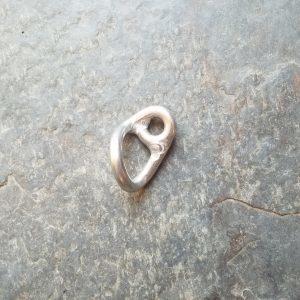
Jim Titt wrote: Interesting hanger design. Can I hang a Team-Tough.com Pigs Tail lower-off directly off that bolt? Last week I installed four Team-Tough Pigs Tail / "rams horn" lower-offs on Fixe horizontal-hole hangers on wedge bolts, connecting via the barrel shackle which I purchased also from Team-Tough. Seemed to work fine for me -- but I'd love to install the Pigs Tail lower-offs over wedge bolts with fewer connecting pieces (and not need to use the 3/8 inch horizontal-hole hangers which are difficult to purchase as Stainless in USA. . . . (and sourcing 316 Stainless from Europe seems like a smart idea). Ken |
|
|
Summary - because of significant risk increase in presence of open gate or partially engaged threads due to manufacturing defect - do not install 3/16" quick links. If you come across some at an anchor - definitely do not trust your life to a single 3/16" quick link - two equalized links may be ok for body weight but there is risk - make sure gates are closed - definitely don't bounce too much - consider not using - replace asap. |
|
|
I've always been a big fan of these in the 6 mm size for connecting hardware at rap stations. http://www.peguet.fr/self-certified-maillon-rapide-quick-links/standard-maillon-rapide?tab=tab-inox Any link that will see repeated falls or is a single point should probably be 8 mm (5/16") or larger, in my not so professional opinion. |