
 Continue with onX Maps
 Sign in with Facebook





Kalymnos Anchor Failure


|
I hate to say "I told you so" but I've been telling them so for over twenty years. Since 2000 I've had huge on-line and email arguments with people like Alan Jarvis, Jim Titt, the leader of the Kalymnos rebolting group and many others. I said titanium is your only safe choice, and they said 316L steel. (And some things are stamped 316 and aren't, adding to the danger) So this accident, while tragic, isn't surprising. And Kalymnos isn't the only place. I've gotten reports that Puerto Rico is still using steel. I was very disappointed that Alan Jarvis and the UIAA didn't ban steel in this type of environment ten years ago. Maybe now, since this is Europe, they'll change their tune. |
|
|
Lord Slime is right! |
|
|
John Byrnes wrote: Yeah, it's been a long haul, and I reckon we still have a long way to go. If you have been following the conversation over on Kalymnos FB, no doubt you will have seen the pontification of "experts". Sheesh! people who don't know what they don't know are a hazard! But, little by little we can win this one. I see the lights coming on here and there. |
|
|
John Byrnes wrote: The UIAA can't "ban" anything anywhere. Steel bolts have been prohibited for sale for outdoor rock climbing in the EU since 1996 (something strenously opposed by the US representative to the UIAA at the time). |
|
|
Ridiculous to suggest the victim should have rappelled. That is old school bs rarely done these days. In a single pitch sport climbing environment, as most of you folks know, rappelling is more complicated and more time consuming than rethreading and lowering. On top of that, many of the routes in Kalymnos are very overhanging, making rappelling even more an unrealistic choice. Let’s refocus the conversation on what matters here. Suspect anchors and bolts is a huge concern. Good to understand some initial steps have already been taken to address the situation. I have had 3 glorious trips to Kalymnos. Given this accident, I will carefully consider whether or not I want to return. |

|
Looks to me like this is Thailand all over again, just at a slower pace than the corrosion seen there. For some historical context, here's Sam Lightner Jr.'s intro to his 2005 Thailand guidebook. Note that they'd seen around 70 bolt failures in less than a decade:    |
|
|
NateB wrote: Except that when you see the photos on the Climb Kalymnos page, you can see the tell tale “black ring.” Not to mention that several seaside crags at Kalymnos have observed sulfate related corrosion. |
|
|
Francis Haden wrote: I was wondering if a GriGri would work. Put it on the belayer side of the rope but the its feed opposite. In theory, as you are being lowered, the rope runs through it freely. If the anchor fails, the pull reverses and the GriGri engages. |
|
|
dino74 wrote: A grigri wouldn’t want to feed either direction across a tensioned line (belay rope taught). I’ve used bet never fallen on a prussic this way. Something like the CAMP goblin might work, but few carry that. If three bolts broke, what’s the likelihood the 4th is going to hold even if a the prussic/backup did? |
|
|
Peter Thomas wrote: Actually it's quite smooth because as GriGri trys to bind, it removes the tension from the belayer. No problems with this 75 pound setup and pulley. No sure how it would translate in a real world setting.  |
|
|
NateB wrote: These were 10mm wedge bolts. Over toqring on wedge bolts almost always will sheer/stretch at where the diameter is thinnest, at the cone, which is not just a few mm into the hole.
is it possible? sure. |
|
|
NateB wrote: This theory (over torquing), while it has merit, was disproven 25 years ago. When I look at the photos from Kalymnos, I see a classic SRB corrosion failure. Seen it dozens of times. And steel glue-ins, with no torque, break in the same place and have the same fractured surface. And I have no problem believing that three bolts of the same age in the same location all failed at the same time. |
|
|
The armchair quarterbacking in threads like this is always a little hard to stomach. “Well if he would have just done this” “How could we have prevented such a tragedy by using xyz technique” No one wants to accept the fact that climbing, even sport climbing is dangerous and horrible things can and do happen. This one has especially struck a chord because it’s seemingly unthinkable that 2 anchor bolts would fail simultaneously just from bodyweight. But yet this is not the first time this has happened to anchors attacked by coastal corrosion. You’re not going to get everyone to start using prusiks (or expect that they would have the intuition to decide that the anchor sucked just from a little rust to make that informed decision) or some other device on the belay line each time they get lowered and the suggestion to rappel instead of lowering would only cause more accidents and wouldn’t have prevented one here. A concern I haven’t seen brought up, and people use setups like this all the time without a second thought is the lack of redundancy in the lowering setup here, the carabiner, quicklink, and lower hanger were all non redundant failure points, while they’re all plenty strong in theory, we can’t always trust this to be the case in areas like this. I think to pontificate on changing how people interact with the hardware, would be to ignore the actual problem. The routes need to be either replaced with suitable hardware or closed. This was an obscure route, that I wouldn’t be surprised if it hadn’t seen a climber on it in some time, it has 0 ticks on mountain project since being added to the site 12 years ago. John Byrnes, have you ever heard of a 316 stainless bolt failing on Kalymnos in particular? My guess is despite whatever the nut has stamped on it that these bolts were a2/304. We have known for decades that this grade of steel is unsuitable for use near the sea. The “bad batches” of 316 steel is another issue, but one that should be addressed easily by any bolt manufacturer of glue in bolts. Quality testing their rod stock for each batch should be the norm. Testing for 304 vs 316 is very straightforward. Route developers are very price sensitive which is one of the factors that can lead to bad quality control by manufacturers. We have a program set up locally whereby the community subsidizes a portion of the cost of hardware for new routes ensuring that only the highest quality hardware is used. One of the biggest questions that no one has brought up is how do we tackle rebolting on routes like this, that see very little traffic and are potential ticking time bombs just to bodyweight a bolt and drill a new one. How do we keep our rebolters safe when there isn’t a good way to access top down? Are we putting our rebolters in too much risk to rebolt routes that perhaps haven’t seen an ascent in 10 years, is it worth it to maintain these types of very low traffic routes vs just closing them? I’ve seen this in other vacation climbing areas where there is little ownership of routes, a climber comes and develops a route or two as part of their holiday and then never returns. While I don’t think someone who bolts a route is responsible to maintain it forever, this dynamic of leaving routes in an areas without LCO’s equipped to maintain them does create problems. Thanks to all those involved in Rebolt Kalymnos, you are doing amazing work! |
|
|
DrRockso RRG wrote: Why do you say that when the nut was clearly marked as A4 L (316 L)? |
|
|
Hey Greg, I was in the process of editing my post when you commented, I hadn’t read the whole thread yet or seen the Andy K photos. I’d be surprised to hear that the bolts themselves are all actually 316, or perhaps were sold as 316 but aren’t, I guess we’ll have to wait and see. The pictures for the one bolt seems like the head was getting absolutely eaten up by corrosion while the nut look more or less fine on the same bolt. Maybe hammering it in marred the surface. You would think they’d be seeing many more bolt failures on older routes bolted with 304, if even the 316 is experiencing failures. Bad batches in marine grade stainless can be even worse than good quality 304, as we saw with fixe’s recalled first batch of PLX/HCR steel, which rusted even in arid environments. It’s interesting that the (non stainless?) chain looks completely fine. Perhaps it was hot dipped galvanized. I recall a few areas where hot dipped galvanized eye bolts were the norm with good success due to the unavailability/cost prohibitive nature of titanium glue ins in their country. |
|
|
DrRockso RRG wrote: Portugal. |
|
|
My point is people tend to bring up "what could the climber have done differently" I know that it's not meant to be hurtful, but it tends to shift the blame towards the victim, or at least place a false sense of security in our minds that "if I just do this, it won't happen to me." The reality is most of us wouldn't have done anything differently. This is part of what makes it so upsetting. Care to point out which parts you saw as arm chairing? |
|
|
DrRockso RRG wrote: You better do a little research before calling me an armchair quarterback.
Yes. And in Thailand, Cuba, etc. What makes you think that Kalymnos is special? It's not.
I've been hearing that argument for 25 years. Yawn. Tired of it.
If you can't figure out how to rebolt them, ask nicely and I'll give you a hint. It's not cheap. And if you have shitty routes, don't rebolt them. Remove the hangers from 1 and 2. No one will notice.
Good questions. If they had developed the routes with titanium, THERE WOULD BE NO MAINTENANCE. DUH!! I've rebolted something like three dozen routes on Cayman Brac myself and quarterbacked twice that many. It's called work. It's called money. It's called responsibility. I had this argument with the RRGCC twenty years ago too. It's not the cost of the bolts, it's the recurring labor costs... that is, if you can get someone to do the labor and cough-up the money. You guys made your bed, now you gotta sleep in it. |
|
|
DrRockso RRG wrote: Total bullshit. Steel glue-ins fail in the same manner as steel expansion bolts. Ask the Thailand boys or check out some of my posts from decades ago. 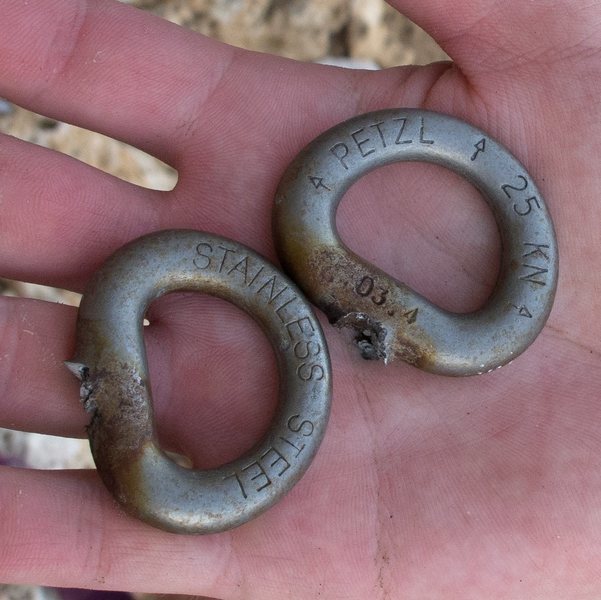 |
|
|
Greg Barnes wrote: I've had deliveries of A2 bolts with A4 nuts, it just depends on what was available (it's normal that the bolt, nut and washer are from different grades and as long as the parts are all above the lowest allowed grade it's fine). |


