
 Continue with onX Maps
 Sign in with Facebook






Man falls to his death while rappelling in Zion National Park


|
Bill Lawrywrote: I'm happy to hear you refer to your wife in the present tense! At least you can't burn your hand with an out of control fireman belay right? |
|
|
How far does a rapeller fall in approximately 2 seconds? And because I’m not well skilled in math/physics: how far does a body fall in 1.5 and 2.5 seconds. @Old5ten: Thank-you. And Thanks to: A Rice & M Pilate. |
|
|
Bb Ccwrote: in pure physics terms (vacuum, free fall) let's say 65' - but ultimately it depends how much friction there is in the system (air drag, rope/device drag). |

|
Cocoapuffs 1000wrote: As I stated somewhere up above, I think an important reminder from this accident is that a fireman's belay is really a way to substitute a more experienced person (the 'fireman') controlling the belay for an inexperienced person above. In case, just for example, the person rappelling loses control of their brake hand, drops the brake strand, etc. In that instance a bottom belay can help regain control. But it's not going to fix a defective rappel that doesn't have enough friction from the beginning or where something failed in the rappel device mid rappel, causing it to lose friction. |
|
|
Bb Ccwrote: Here’s a quick table that answers your intermediate time/distance questions  As you can see (again like old5ten stated: neglecting residual friction still in the system) in the case at hand with the rappeller ~200 ft up, he would be hitting the ground in about 3.5 secs. So a 2 sec delay in the bridge test for someone to fall 65’ before attempting to arrest is a little over the top as far as real conditions go in my opinion. -Agree with Andrew in that a belay will not overcome a faulty system, but that said, a bottom belay can (it’s possible) take over and manage an otherwise insufficient system from the standpoint of a rappeller alone. Insert Lots of caveats here —not the least of which is how the rappeller/device/belayer interact and when Odds of success drop drastically with a stack up of adverse conditions |
|
|
Mark Pilatewrote: Freefall through air is very different from losing control of a rappel. I'm sure the accelleration is much more gradual because the rappel device and the person trying to brake are still going to create significant friction, even if not enough to stop or slow down enough. |
|
|
Andrew Ricewrote: I agree, and that’s my earlier point about the bridge test “ time 0 “ starting conditions, but after free fall has begun, you’d be surprised how negligible it is after say the first 1/2 second. If unrestricted says 3.5 secs, I estimate the rappel free fall not to be over 4 secs |
|
|
Andrew Ricewrote: I used poor wording in my question. When I said 'out of control' rap, I was including your first situation - the rappel setup is NOT defective but the person rappelling looses brake hand control. Which I assume is the most common mechanism for climbing related rappel accidents (except for rapping off the end of the rope, obviously) |
|
|
Andrew Ricewrote: Remind me what sort of device the bridge test was using? Was it a normal ATC style tube device? These canyoneering devices like the one used in this accident seem to have very different functional modes and, also, failure modes. |
|
|
M Mwrote: Absolutely! I felt pretty sheepish that she went so far under those conditions. Only mitigation I can think of for starting to lower someone that way on an ATC would be to cycle quickly between more and less tension on a decreasing trend. . Don’t even want to try it.
I really wonder about that. The belayer in this accident received “severe rope burn/bruising”. Conditions were certainly more extreme than mine. Still, at a minimum, physical reactions out of alarm can be severe. |
|
|
Bill Lawrywrote: it's pretty amazing your wife went for that experiment - kudos to her. not sure what the safeguards were, but i'd definitely recommend a third person with a TR belay and a hard stop way off the deck in any experiment like that ;-) rope burn/bruising brings up another tangent, the use of gloves. maybe that should be more common with certain types of rappels/belays?! |
|
|
Yep - that’s the way to do it. Folks should try it under controlled circumstances as a learning experience. Good rope-handling gloves are under utilized IMO. |
|
|
Photos of some techniques not shown in the Kong user instructions... Rigging depends on whether the user is directly plunging into deep water (or not), and also experience level. Hydrobot could benefit from a more aggressive horn (like the 'Scarab', which is my personal favourite device for canyoning).  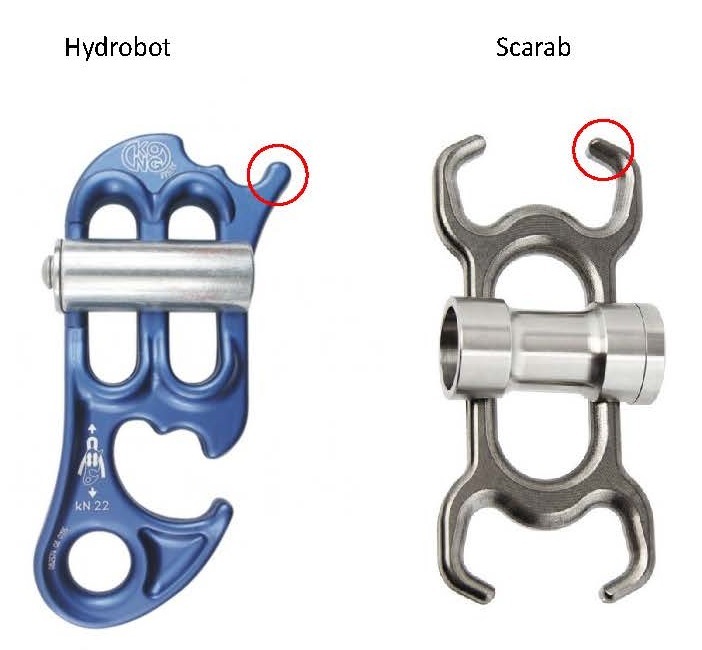 |
|
|
Mark Gommerswrote: How does the Scarab attach to the harness? Agree that "horn" on the Hydrobot appears dangerously small. |
|
|
let's be mindful of the fact that someone died. i like the exchange of ideas, the scenarios, the research, the hypotheticals, and the learning process, but maybe the blame game should be a new/different thread... |
|
|
@ Cody L -- The tone of your post has no place in a thread where somebody died. In addition, your post is illogical -- read it again carefully -- you contradicted yourself. You should delete your post. |
|
|
Andrew Ricewrote:  |
|
|
Bb Ccwrote: Thanks! |
|
|
General question, why do canyoneers have these super fancy rappel device? I've never gone canyoneering, but I've done a few long raps while climbing, and I've never thought "The ATC or gri-gri isn't good enough" Is this much variable friction really needed? Is it a weight savings thing? whats the history here? |
|
|
JJ Marcuswrote:General question, why do canyoneers have these super fancy rappel device? I've never gone canyoneering, but I've done a few long raps while climbing, and I've never thought "The ATC or gri-gri isn't good enough" Is this much variable friction really needed? I’ve done some dry canyoneering and we just used atcs for the raps. They worked just fine even for long free hanging sections. |


