
 Continue with onX Maps
 Sign in with Facebook






Yosemite Helo Rescue 7/10 - Half Dome ?


|
|
Gina Schaeferwrote: Not every route needs to be climbed by every climber. |
|
|
Austin Donisanwrote: I agree. I believe the "off-route bolt" is on a climb called Snake Dance which is not shown on the SuperTopo. And it should be shown, instead of just "NO!". The SuperTopo is good in showing that there are 2 separate dikes, and you have to do a big traverse left to reach the second dike. However, we don't know if they had the SuperTopo, or the Sloan guide. The bolt was actually placed by Eric Beck on the first ascent of Snake Dike, before they decided to go left instead. 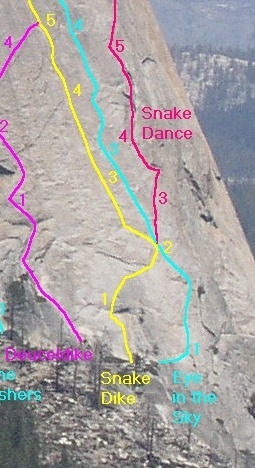 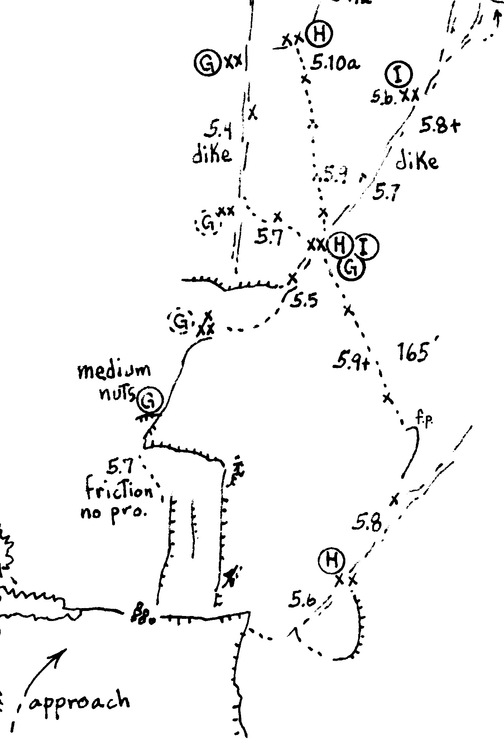 Part of the 1994 Reid topo. I believe she was heading for the first bolt on Snake Dance (I), just above where it says 5.7. Regarding the accident, not seeing the bolted anchor on this route is the main cause. Or maybe seeing it, but being confused and thinking she was not supposed to clip it. It sounds like they were a little late starting the climb, and they might have been rushing things a bit. Normally you would be extra careful on one of the two 5.7 pitches on this route. I have led that second pitch, and I agree with the SuperTopo version that it is 5.7, well above the bolt, not just 5.5 below it. The third pitch left traverse is technically slightly harder, but is very well protected at that hard move. All pretty tragic; they were new to Yosemite and were probably not used to spotting the bolts. |
|
|
"If you want to make the argument that those things should exclude us from the route, then fine, but understand that that is the argument you are making and it is ego based. " I'll make that argument. If you want to climb a runout route, but are unable to due to a mental block, lack of experiance or inability to commit, that's a personal problem. Why should the mountain be dumbed down because of the way YOU wanna climb. Anyone can put up a FA, go nuts, be as safe as you want. You don't permanently alter a historic route because you don't have what it takes to climb it. Your entire reply boils down to asking "Why should only bigwall climbers get to go up elcap? Why not just fix ropes the whole way up, make a rope tow, carve an elevator shaft through the great roof. I've got plants that need me to take care of them, I can't risk having gear pull. You are excluding those of us who want an easy fun safe vacation, it is elitist. Yosemite valley is basically just a suburb of fresno at this point. Go climb a REAL mountain if you want a modicum of adventure. We all know exploration, testing your limits, facing the human condition and embracing personal responsibility. These things have no place in Disney world" |


|
Not sure which side I fall on, but I don't buy the "you don't have to climb it" argument. In theory I agree but the reality is that everyone and their dog are climbing certain routes that see many, many accidents. If we know another 15 gumbies a year are going to deck on Double Cross, I don't think that human toll is worth "the ethics". |
|
|
Big Redwrote: Why even climb snake dike if not for the mental battle. Its a feeling of accomplishment that transcends generations a living and interactive history. You can push your comfort zone, experiance radical self reliance and form a bond of trust with your partner. Hundreds of people a year find these same challanges, rewards and sometimes tragedy on the cables. A smaller gaggle of people will find this adventure on the Regular NorthWest Face of halfdome. Each route is different, experiencing the different character of the First ascencionist and geographic features is a good thing. It's a progression, and if you are happy hiking vernal falls then all the power to you. All we are asking is not to ruin the progression for the rest of us, for the future generations. More people die on the cables than snake dike , adding permanent anchors won't make it safe. It will only change the thing we have all grown to love and pervert it into something it's not. I wonder how Bachar, Gobright or Dean Potter would perceive this discussion. |
|
|
I'm not advocating either way, but there is some key historical context to consider, which I've not seen mentioned anywhere so far. The second ascent of Snake Dike involved Steve Roper adding bolts to the route with the first ascent party's permission. The 1965 FA team of Eric Beck Chris Fredericks and Jim Bridwell were looking to do a harder climb when they found the classic easy route. They didn't have nearly enough bolts with them but they were skilled enough to easily complete the first ascent with scant protection, thus: A couple of days later Beck’s mentor and friend Steve Roper, the Valley guidebook author, marched up there. Beck implored him to add bolts, at the belays for sure, and some for protection too. Roper did so with an emphasis on "some" and came back with the verifying story. A few days after that, Tom Kimbrough made the third ascent and certified the dike as an unlikely and amazing line, mostly 5.5 and easier. Almost overnight, Snake Dike became everyone’s fun-jaunt up Half Dome, and the previously popular Salathé Route (Southwest Face) to the left fell into obscurity. Today, the old 1/4-inchers have been replaced with stout 3/8-inch stainless bolts. But the spacing as defined by Roper’s ascent remains scanty and serious, and there have been fatalities. Beck himself argues that more protection bolts should be added, but Snake Dike remains a Tuolumne-like challenge for runout-ready climbers on fair-weather days. [source: https://www.rei.com/blog/climb/wild-history-yosemites-popular-route (2017)] I've read other accounts in which the FA team expressed that the route was so good they wanted to make it safer and more accessible. This was an unusual practice during a time when climbers prided themselves on bold, ground-up first ascents. Very sorry to read about the young woman's terrible misfortune. So sad. I hope she makes a full recovery with a prosthetic foot. |
|
|
Yeah - there is no way she climbed by those p2 anchors without clipping them - there are some missing or incorrect details here. I’m not sure I can recall anyone getting beat up so badly from a slab fall that was eventually caught by the rope. Nasty! Snake Dike is not a beginner route. Taking those runouts on legit 5th class terrain is not at all chill without considerable mileage on granite. If you’re ready - the bolts are about average spacing for the grade on slabs, IMO. |
|
|
“He that is without sin among you, let him first drill the retro” John B. 8:7 |
|
|
What a horrible nightmare accident in both cases. Wishing a speedy recovery. |
|
|
Bash the american medical system's prices, but they got her put back together pronto. They installed artificial spine vertebrae almost immediately and seems like she is getting the best possible care. Hopefully she will be active again eventually and not wheelchair bound |
|
|
Ryan Sheridanwrote: And yet you avoided answering the question, why can't you simply not clip the bolts. Are you so weak in your mental game that you have to clip every bolt you see? Maybe work on that as part of your mental battle. |
|
|
aikibujinwrote: Why do we need to feel obligated to help you overbolt a route that you are afraid of getting hurt on? Do we need to chip hand holds and feet for the hard parts as well? Maybe work on sounding less selfish. You’re like the fat people petitioning for a elevator that goes to the bottom of the Grand Canyon because it’s unfair that you need to be in generally good health to walk to the bottom of the canyon. I’m not courageous enough to do those run outs currently; but i look forward to it sometime. |
|
|
Erik Strandwrote: Safe bolting does not equal over bolting. A route should be safely bolted to prevent death and serious injury, that's not over bolting. I'm a fat person that's selfishly asking for a well-maintained solid trail that goes to the bottom of Grand Canyon, instead of a loose and eroded slip-and-slide that if you fall you break every single bone in your body. |
|
|
aikibujinwrote: You, the main character; staying fat and unhappy because the world refuses to bend to your expectations |
|
|
Derek Fwrote: Interesting counter point if you had bolded a different passage: Beck himself argues that more protection bolts should be added, but Snake Dike remains a Tuolumne-like challenge for runout-ready climbers on fair-weather days. |
|
|
aikibujinwrote: And who exactly gets to decide what is "over bolted" or "safely bolted?" You? Someone who wants a bolt every three feet? Lowest common denominator? If it is you that makes that decision, tell me why it's you and not me, or someone else. Your safely bolted ruins the experience for others who want to experience history, a challenge, some level of danger/adventure. Total chaos will result if climbers decide that adding bolts to climbs that are not "safely bolted" is OK. Stick to modern routes if you don't like this. The modern ethic is to bolt more closely. For safety and comfort. |
|
|
aikibujinwrote: Because that most assuredly changes the character of the route. Why not put up a via ferrata cable along the entire route? After all, you can simply not use it..... |
|
|
I'm gonna try to post an essay I wrote on this subject a few years ago. I was doing my best to answer a climber who asked: "As a "young" climber, I have yet to hear a compelling reason why the FA party should blanket own the route." It's a long essay though and so I earnestly hope that NO-ONE READS IT. This is the internet, after all, and the world will end if anyone reads more than the first two lines of any given post. |
|
|
While I go back and forth on adding pro to old climbs that might not have been bolted intentionally (like SD… as noted the FA would have used more if they had em)… I am not sure more bolts will help on Snake Dike. Nothing short of a ladder is going to help folks who are inexperienced on slab and route finding on long routes. Whether it’s here, or the flatirons, or the alpine, I suspect folks who are in trouble don’t respect that the grade may refer to the hardest moves, but the skills and experience needed is unrepresented in the number. |
|
|
1. This ethic avoids chaos: If the decisions made by the first ascent party aren't to govern the route after the first ascent, then what will govern it? It bears repeating - what "rule" would apply if it isn't this one? It seems obvious that if any climbing party could add bolts to any route, total chaos would result. To an extent, the same result would follow if any party could subtract bolts from a climb, too. There's no way that all climbers will ever agree on what is the higher value as between safety and risk. Parties will (and do) disagree on what makes a good route. They disagree on what makes a fun route, and they disagree on what makes a challenging route. There won't be agreement on this subject in general and there won't be agreement on it as to various, specific climbing routes. And so, if there is no "rule," no strongly held consensus of whether a route can be "changed" after its first ascent (especially by the addition or subtraction of bolts), parties will add bolts and they might also subtract them at will. In short, total chaos would result. Neither the rock itself (which is highly worthy of respect) nor the climbing community would benefit from such chaos. A hard and fast rule (especially one steeped in tradition and history; see below) is one very good way to avoid such chaos. It may be the only way. 2. This ethic is clean and easy to apply: Again, if the decisions made by the first ascent party aren't to govern the route after the first ascent, then what will govern it? What rule will apply? If this rule isn't valid, then can a route be changed after the first ascent by consensus? If so, how strong a consensus, and who decides? How is a consensus to be formed? Would a consensus to make a route more dangerous require a stronger consensus? What about leaving such decisions in the hands of the "best" climbers? Would that work? As an exercise, find me five climbers who can agree on what makes up the "best" climber. Just five who agree. Not likely? Am I a "better" climber because I handle risk better than my buddy who climbs only on "safe" routes? Or is he the better climber because he leads 5.12s, while I max out on 5.11s? I can't imagine a different "clean" rule, one that's easy to apply and is thus likely to be followed by a vast majority. Can any other climber here plainly and clearly describe such a rule? 3. This ethic has a strong tradition: This argument in favor of letting the first ascent party "own" a route - "tradition" - is the best known and most frequently made. And it's a damn good argument to many. It's especially a good argument to those who enjoy the history of our sport. After all, what place in history would routes like Bacher Yerian (in Tuolumne Meadows), or Conduit to the Cosmos (at Pinnacles) have if they'd been dumbed down by subsequent ascents? 4. This ethic would prevent the "dumbing down" of all routes: I, for one, value risk as an essential element of climbing. I'm glad that I'll never exist in a climbing world where all routes are "safe." I even resent those who try to make all routes "safe." Should all routes be safe? Aren't there plenty of safe routes around? Or should all climbs be gym-like so that injury is factored out and climbing becomes an exercise in outdoor gymnastics? The question is phrased in a way that makes my answer to it clear. Is there really any climber out there who wants all routes to be equally safe? And, in the unlikely event that anyone can truly answer "yes' to this question, don't we circle back to the question: "then who gets to decide what "safe" means? 5. This ethic shows respect for others: So, a clear and easy to apply "rule" prevents dumbing down every climb; it prevents chaos. What other value does such an ethic have? It fosters respect for others, respect for other people; in this case other climbers who came before us. The older I get, the more that I value respect and kindness toward other people. In climbing and in life in general, discounting other people's values can be insulting and disrespectful. In this sport, there's tons of safe climbs out there, and tons that aren't safe. Is it really ever necessary to "tell" the first ascent party that their decisions were "bad" decisions by altering what they did? I don't think so. As demonstrated in other threads on this forum, other climbers are willing to do that (and, ironically, the "other," disrespected climbers are then willing to be jerks to the original offenders and thus perpetuate a vicious cycle). |


