
 Continue with onX Maps
 Sign in with Facebook






Petzl says simul-climbing is more sketchy than I thought



|
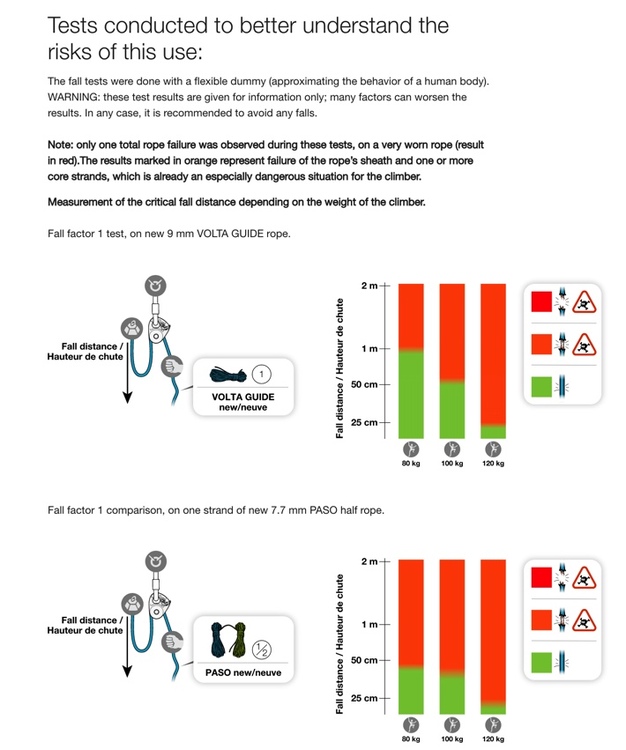 My takeaway: if the follower has 1 meter of slack in the system and falls that there’s a decent chance the rope will get core shot. I knew this was a risk but didn’t realize how little slack it actually takes to core shot the rope. Has anyone taken big follower whips on micros? Thoughts? |
|
|
Notice that the fall factor is 1. The graphic shows the climber falling from a point starting at the micro-trax. That's a fairly severe fall when the anchor is static. |
|
|
Jordan nailed his response, but I'll add to it. The subject of this post, simul-climbing, is not represented in this test. The worst fall depicted in the linked article is a 2m fall, using 2m of rope, which is a pretty serious fall factor 1. A scenario more realistic to the simul-climbing situation would be the follower falling 1m with 30-60m of rope absorbing the impact, a more mild fall factor of 0.03 or less, which would impact a micro-traxion placed in the system far less. This means that the information in the article is not very relevant to simul-climbing. |
|
|
John Hegyeswrote: Agreed. Theres either a lead fall, which doesn't initiate the trax, or aTR fall that does. Those are not depicted in this article. |
|
|
Is a micro trax still the preferred progress capture for simulclimbing? Or is there another advice with a lower chance of damaging the rope (e.g., WC rope man)? |
|
|
Drew Scottwrote: I prefer the CT Roll'N'Lock |
|
|
All of this creative simu-climbing stuff using gear as it was not intended is just an accident waiting to happen. Probably already has. |
|
|
Don't fall simul-climbing. Lord only knows what will happen. |

|
A V wrote: Correct me if I am wrong but I thought their accident was due to a fall with lack of adequate protection not a failure of a rope grab or any fancy equipment. |
|
|
Noel Z wrote: So you're saying that if I have 1m of slack in an overall distance of 50M between my (the follower) and the Traxion, that is the same as falling with solely 2m of rope, slack, while next to the Traxion? |
|
|
Ben Podborskiwrote: He's saying that he's talking out of his ass. |
|
|
This article from Petzl would be worth reading if you don’t have a grasp on how fall factor and impact force are related. Petzl fall factor and impact force
Edit to add: AV- I did get the impression you were placing some blame on a progress capture device. And totally agree that simul climbing for sure can add risk. Like many techniques it should be applied in the correct situation and the climbers should be aware of the risks. For some people the reward of simul climbing is worth the risk. For others it isn’t. I’ve done lots of it and will continue to do so for certain objectives but will also say no in other scenarios. |
|
|
It's natural and appropriate for engineers to test the worst-case scenario, the one involving slack in the rope as the second arrives at the anchor. It's not at all hard to create this situation when simuling, although it is avoidable if the second can pause to let the slack get taken up. The take-away is to try to keep slack out of the line in general, but especially as the anchor is approached, and if that can't be done then think no-fall zone (which should be the mindset for simulclimbing anyway,,,). Too bad Petzl didn't also test some of the more likely cases involving smaller fall factors. |
|
|
You can easily use a second Petzl product (possibly their best) to manage slack on the follower side; a Grigri! |
|
|
Ben Podborskiwrote: This is a dependable option for the second to manage slack. Any experience out there for a lighter version- ie: if the second has a microtraxion on their harness? |
|
|
Greg Rwrote: The nice thing about the grigri on the harness is that you can then pay that slack back to the system one handed much easier. |
|
|
Andrew Boechlerwrote: Idk abou that, try lead belaying with a grigri one handed (granted I still use the original grigri) |
|
|
John Hegyeswrote: Thanks for everyone’s thoughtful responses! This post def cleared things up for me, idk why I didn’t realized this at first. |
|
|
A V wrote: Thats a really good idea. Thanks for sharing that. Seems obvious in retrospect, but in the moment that's a solid quick decision. |
|
|
If you think about it... one interpretation of this Petzl test for simulclimbers is to possibly make the minitraxions as widely spaced as possible for safety. Now that is interesting. Thoughts? |
|
|
steve barrattwrote: That's usually how it plays out from an efficiency perspective assuming the terrain is homogeneous in difficulty. If it's all the same, you just run the rope out, place the first trax, climb another rope length, and repeat until you're out of PCPs or are on terrain that you feel okay simuling without one. If there's easier terrain mixed in, you could potentially skip a placement or stretch out that interval. If there's a specific crux you're trying to protect the leader from the follower falling off of, you try to time the placement so that the leader places the trax just before the follower starts the crux. Edit to add: weighing the risks one exposes themselves to while simuling, I think the leader being pulled off by the second's fall (caused by a slip, rock breaking, rock/ice fall, etc) is much more likely than the second falling with enough slack out to damage or cut the rope on the PCP. One is pretty much entirely controllable by being smart and not climbing into slack and/or managing it with a grigri. The other is much more difficult to safeguard against. |


