
 Continue with onX Maps
 Sign in with Facebook






Technique Question: Surmounting Foot Ledges
|
|
What's the best technique for getting up on a small foot ledge that has a steep wall right behind it? It's usually fine for me when the ledge is deep enough to do a normal top-out sequence and stand up. It's also fine when the ledge is shallow enough that I can basically just climb past it normally until my feet are level with the ledge / flat spot. But I'm finding it really awkward when the ledge is around two or three feet deep. There isn't enough room to do a normal top-out and the angles make it feel like I have to pull way outwards on my tool in the wall above in order to move my feet up. It feels like pulling outwards that much significantly increases the risk of the tool popping, especially if I can't get the high tool really buried. What's the solution here? Thanks. |
|
|
I've used side pull... Or approached the ledge from an angle to lengthen my reach. |
|
|
Climb delicately and use your feet. Try to focus on placing your front points into the pick holes you made. Don’t get too stretched out, easier to mantle up on your tools and stand on your feet than to constantly try to work your tools six inches higher every time you take a step. |
|
|
Swing, Swing , kick, kick. all there is to it ;) every hold is a bucket ;) |


|
John Goodlanderwrote: I don't think you've gotten any great answers yet. I find these types of terrain to be challenging/awkward as well. I think your description of the problem as a "foot ledge" was a little confusing, so I drew a cartoon of what I think you meant. 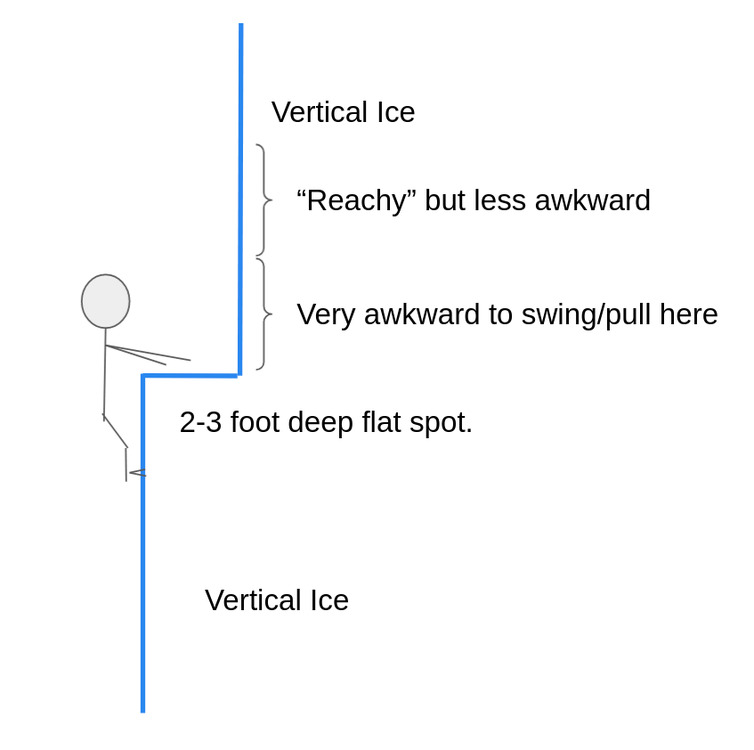 I think the keys are: 1) Go slow/take your time. I know I'm always rushing to get to the good rest, but take it slow. In this type of situation, you should be able to keep your feet well-weighted/have a good rest before making any committing moves, because the ledge should allow you to keep your upper body over your feet. 2) As you mention, if the flat spot is only 2-3 feet deep, it limits the ability to employ normal top-out technique. You can "stretch" the depth a little bit by going a little wider with your tool placements. 3) As you mention as well, swinging and weighting tools on the what would be an easy reach is very awkward, both to get a good stick, and to pull "down". I usually find myself working my feet/tools as high up as I can on the flat section, and then reaching as high as I can accurately swing to get the next stick. This is obviously complicated if the ice is candled/featured in anyway that makes this difficult. Sorry, I don't have a magic answer either, after writing this down it all seems obvious. Take advantage of what the terrain gives you, and maybe approach from the side if the ledth is narrower/deeper there? |
|
|
Funny I was just thinking about this but haven't had a chance to try it yet. Think of a mantle in rock climbing- you would place your hand near the edge, palm towards the wall, and push yourself up. My thought was to place a tool near the edge then grab it backwards- in other words thumbs down, so that the leverage of your elbow would push you towards the wall rather than away. Just an idea. I have yet to try it out. |
|
|
If at all possible put in a screw. You can even yard on the damn thing; better than falling. And, as mentioned above, always pull down on your tools |
|
|
I agree with others that have mentioned attempting to mantle like when climbing rock. Obviously a slopey ice edge isn't a great spot to palm and support your body weight, but in cases like this I get a good stick with my tool and then grab my tool head using the seldom seen "4th" hand position. Elbow down and fingers wrapped around the tool head as if arresting a fall with a mountaineering axe. Practice on toprope to get a good feel for what movements can cause the tool to pop when held in this position. |
|
|
saying always pull down not out is classroom talk. in real life sometimes you have to pull out, sink it hard into the shelf, walk your feet up, sink it hard into the vertical ice. If the feature allows a side swing that might be easier. crank on it and get into that rest. placeing a screw before the move is a decent idea. |
|
|
Thanks for the replies. I went out yesterday and tried all of the suggested techniques. For anyone interested, the methods suggested by Sean M, AV, and Nick Goldsmith were the most effective. Smaller moves, high feet, and getting more comfortable with some amount of outward pull on the high tool help a lot. I can see this being a lot harder if the ice above the ledge isn't good or deep enough to bury the high tool. Mantling the tools or making any move resembling a rock climbing top out was by far the worst option. This felt awkward and insecure even after doing it three or four times. |
|
|
I´m by no means an expert. But I think I generally try to reach with the swings and that I also make a lot more tool placements per height gained than otherwise. It's also quite a bit harder to get good tools from the awkward positions involved. |
|
|
The best way to mantle a tool is typically to start in the “high dagger“ grip position. Once you get your feet up and your weight forward, you should be able to switch to a “low dagger“ grip and fully extend your arm. With one arm locked off in the low dagger grip, it shouldn’t be too difficult to swing into the vertical ice beyond the ledge. With a bit of practice, it shouldn’t feel awkward or insecure. |
|
|
I don't think I ever mantle in this situation. I do use the upper grip possition on my tool to get high enough to swing into the verticle section above. I also don't think about it and just do it so who knows? |


