Continue with onX Maps
 Sign in with Facebook






Tying Two Ropes Together


|
|
climber patwrote: |
|
|
My bad... made an assumption because ends weren't shown in your original photo. Water knot, EDK and Brotherhood/Competition knot all look the same if you don't show the ends or how it's loaded. |
|
|
j Rocwrote: So maybe we should start using the flat fig 8? These tests completely disagree with what I have always heard about the flat overhand and flat fig 8. Guess I won't tie any knots until Ryan Jenks gets the drop tower running. |

|
If I'm rigging the descent, I just use an EDK, and get buy-in from whomever I'm descending with. I've used it with stuff like 10.5/8.5 and 9/7.5 rope combinations without issue, but I don't think I've ever loaded up an EDK with a 3kN dynamic load that Petzl cautions about in their note on dissimilar rope diameters. I've probably used a 9/6 or 9/6.5 combination, too; the skinny line was the other guy's cord, so I forget the details; but after 3 or 4 raps, I didn't notice the knot shifting around; not to say it didn't or couldn't, just that I didn't notice nor was it a concern at the time, but you don't know what you don't know. |
|
|
J Cwrote: Yeah, I always thought the "flat figure 8" (not the Flemish bend) was to be avoided. And I still will. |

|
I use what Andy Kirkpatrick calls the "Half Gibbs Offset Bend" Fig 156 ( andy-kirkpatrick.com/blog/v… ) and Mark Gommers calls the "Offset Bound Overhand Bend" ( cdn2.apstatic.com/forum/119… ) It's Flat Overhand with one strand passed though the knot a second time. Kirkpatrick says: "Although less well known, this is perhaps the knot we should all be using, as it works better when dealing with miss-matched ropes and is also more forgiving, all for one extra loop around." Gommers says: "The addition of one additional binding turn enhances stability. Works with unequal diameter ropes. Jamming threshold is approximately 3kN. Instability threshold is above 5kN" |
|
|
While we're at it, there's always the paketknoten, but I mostly employ it for cordelette (esp. tech cord). https://de.m.wikipedia.org/wiki/Paketknoten Otherwise, the offset overhand (aka EDK) works fine for most contexts. For mismatched diameters, the thinner cord should be behind/under the thicker cord to make it harder to unroll. Exceptions exist for the new specialty skinny lines (ex. pur line and maybe rad line, but I don't remember exactly), so read the technical notice (hence the petzl info posted upthread). |
|
|
Derek DeBruinwrote: I was surprised that the Petzl tech tip drew the EDK with mismatched diameters with the larger diameter cord outside the smaller. But they also said EDK doesn't work with mismatched diameters, and didn't address the diameter order at all. Weird tech tip all around this time. |
|
|
wivanoffwrote: I'm going to start using this Half Gibbs Offset thing. Thank you for posting that. |
|
|
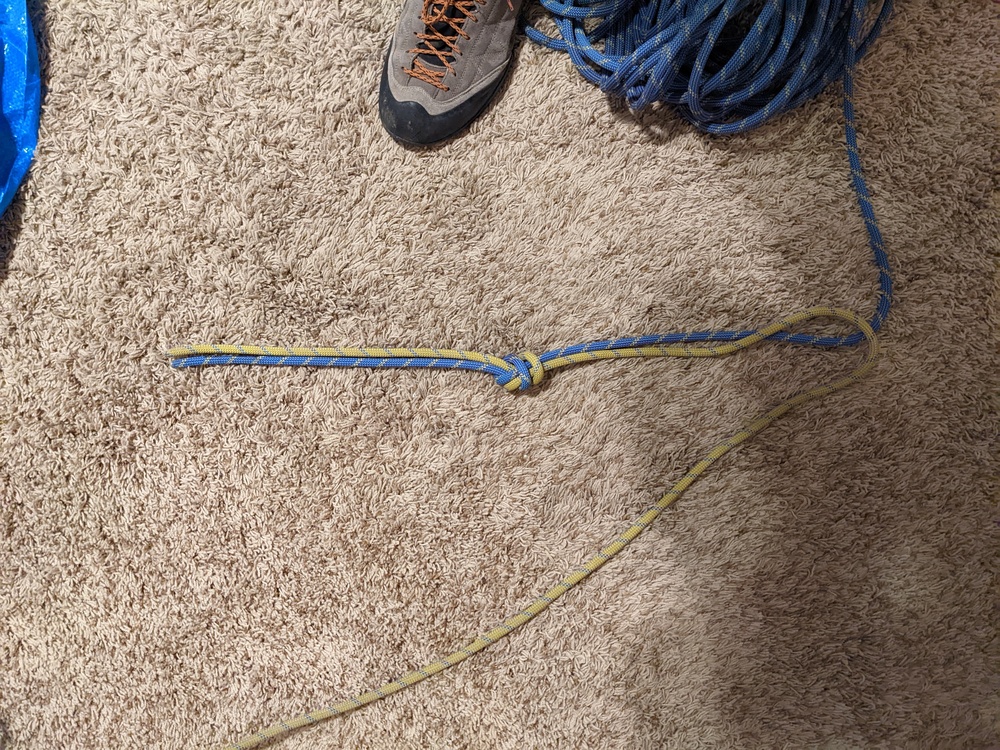
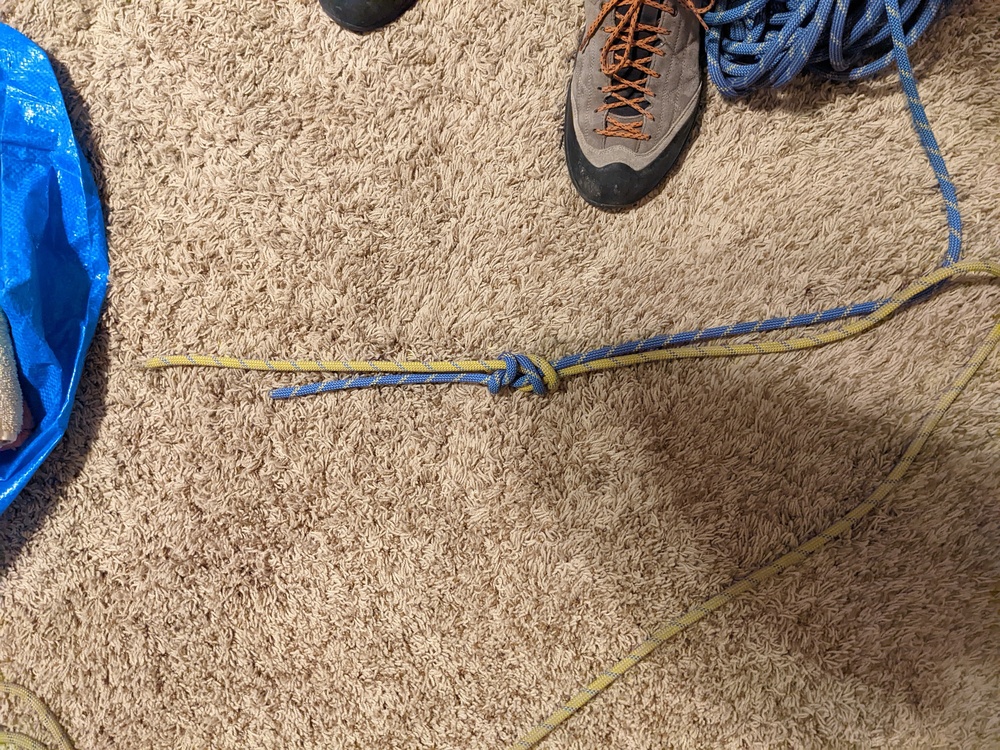
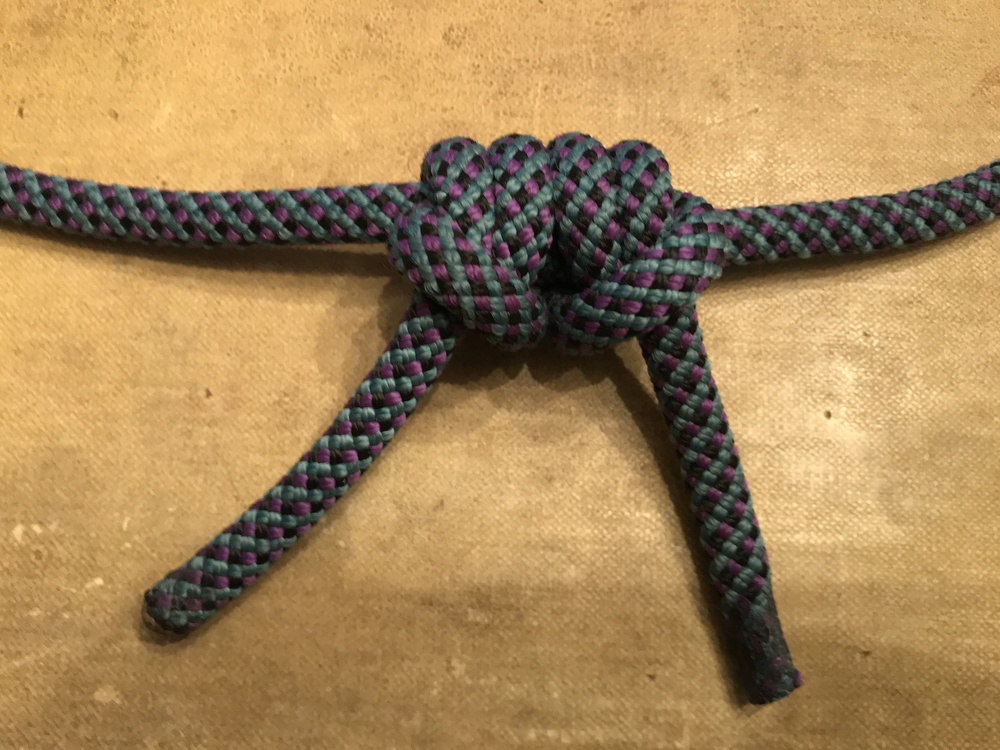
Climber Pat's knot is indeed an EDK with extra overhand, I've been using it for many years, but have switched to an EDK with an extra tuck from Mark Gommers, which is even more compact. Edit: this is the knot referred to in Andy Kirkpatrick's book "Down" as the half Gibbs offset bend. 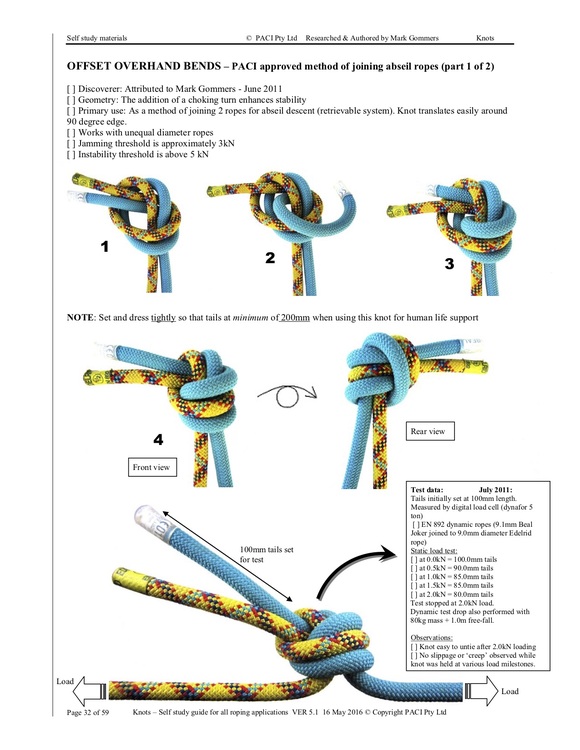 |
|
|
Is it better to make the extra tuck with the skinny line, or the thicker rope? |
|
|
Kevin Careywrote: I tie it with the smaller rope on the "bottom". The smaller rope would be the blue one in the photo RGold posted. So, the extra tuck is with the skinny rope. BTW, the first time I ever heard about this knot was when RGold (thanks, RGold) posted about it several years ago. I've been using it ever since. |
|
|
Does anyone ever retrace a figure 8? Not overhand 8, a retrace end to end. That's what I learned to do way back in the day. |
|
|
Bill Wwrote: That is referred to as a Flemish Bend. Good for tying two rope together, as you mentioned. |
|
|
Ty Fluthwrote: What kind of fishing? Like commercial? Single fisherman’s, aka “lovers knot” , square knot, sheet bend, double sheet bend worked best |
|
|
FrankPSwrote: Thanks. Yeah super flat, works great. |
|
|
rgoldwrote: IIRC, I think it was to The Taco (else, RC.com) that I presented this idea some decade back or so. There used to be some photos of it I think posted by RGold to The Taco (RIP). I recall posting images of the Offset 9-Oh & another?, on-line, <google-google-google> --aha, voici: [url] igkt.net/sm/index.php?actio…;topic=5555.0;attach=20703;image[/url] There are different mechanisms that one might employ to stem flyping --the prying apart inherent in offset loading. With the Offset 9-Oh, a full wrap is made by the choking strand; and it's pointless --actually, detrimental-- to repeat this with the twin strand. (I.e., e.g., in the offset grapevine the choking line in a STRANGLE KNOT (not a "half-a-dbl.fish."!) does its job and so the abutting knot of the other strand needn't be another strangle but a mere overhand ("oh"). Another knotting mechanism is to secure the not-so-much-wrapped choking strand so that it can't pull out and open the knot. One can do this by tying of that strand's tail with an OH around the other strand (usually, it should be thinner doing the choking and tying off to the larger). The tying-off OH acts qua stopper to arrest pull-out of that choking strand. Mark's favoring the variation taking the extra wrap up in side the knot, staying "twinned" to the other had disappointed me, for it lessens the effect of the extra turn, opening the would-be tight wrap to a greater helix angle ... . But then I realized that it has some good effect from the tying off of the strand as per using a stopper. 6 of one, half doz. of other? NB : The cited AndyK page MIS-illustrates the tying step, having the darkened stand not in the choking position --which it assumes, correctly, for the final image, at least.
DO PLEASE READ & UNDERSTAND THE POINT ABOUT >>ORIENTATION<< OF KNOT BODY, which Mark had nicely captured. This was part of that old post I made, when I realized that --take the PACI/Gommers's bottom image above for reference-- that one can essentially reach out to such a knot (say, lying upon your desk before you) and rotate the body over a range of about 180degrees! In the image above, the yellow strand (from left side) rises up into the body in a backward LOOP; the blue ... in a forward ARC; wrapping one's right hand around this knot so positioned one can rotate it clockwise (viewed from above downwards) so that the reverse is effected --yellow arc, blue loop. As Mark notes, it's not been tested to see what variation in vulnerability to flyping/rolling exists; my surmise as that the mid-range position (both strands rising up and then turning) might be worst --it's the one with tails ALIGNED with the axis of tension (vs. being roughly perpendicular to it). And although my initial reaction to what is perhaps most perspicuously named "EDK-backed-EDK" (presented also a good while back, by NeedleSports was it?) was that it was an awkward, inelegant & material wasting solution, I've come to see it as a very good knot-to-know; that it probably can endure all manner of mis-tying (within reason) and still hold --which is the goal (as well as being offset for easy flow over rough surfaces/edges. Think "fatigue, cold, wet, or white-out, gloved hands ..." and this knot might be the simple one to use, 2 B Sure. It has the ability to be tied with the back-up EDK either done first or 2nd :: by which I mean that if one makes the first one and then "oh, damn, these tails are really long enough to tie another...", the 2nd can be tied *inside* the first. (Somewhere I recall seeing that someone had managed to get this knot to roll --surely at non-abseil loads but much higher--, but IMO it shouldn't. (Nor should one be content to tie it sloppily; just that it has this tolerance for slop.) As for this "Gibbs" knot, I don't like it. It has the interior --NOT the choking-- strand making the full/extra wrap :: wrong place, you're letting the choking strand run --bad. He writes "This is also an ideal variation to know if you’re looking at higher loads" ?? Where's any testing evidence of this? (I do like how folks will preface knots talk about how strength is irrelevant, then mention it over & over --I think it's Setnicka's Wilderness Rescue where this achieves a comical state!) .:. MUCH prefer the Offset 9-Oh; or some of the others. Rather than break testing --and for that, mostly, simply high-load testing neverminding upper limit should show enough--, there needs to be more cyclical low-load (forces like actual ones) testing, to check about any *ratcheting* out of material. (I was able to see this one time in playing around w/6mm kernmantle accessory cord, manually loaded. Other times, not so much!?) IMO, rope conditions that might lead to trouble are : elastic ropes, frictive/worn covers --such that pulling out on the SPart is more likely to draw the choking part with it than slide & tighten !? Also helpful, SET THE OFFSET KNOT CORRECTLY :: tighten the knot and esp. the choking strand, pulling on tail(s) as a penultimate step; make the final tightening by loading the SParts HELD TOGETHER SO THAT THE KNOT IS LOADED QUA **STOPPER**, not ends-joint. THEN you get a good tight knot, to resist the pulling apart in-use forces. I think that this aspect of setting is what can leave the offset Fig.8/Flemish joint so vulnerable to flyping. *kN* |
|
|
rgoldwrote: Actually, this is one more of the stupidities in knotting --YMMV. The "double Uni" aka "Grinner" and ... , is from angling's knotting world. Typical of angling-knots presentations is a detailed step-by-step tying instruction including setting guidance ("pull tippet & tag end ...") and --presto-- one achieves the result, which usually is an indecipherable graphic squiggle ! I was recently piqued about the "Grinner" aka "Uni" knot, by Philip Pettit's Why Knot? book's assertion that these outer reaches of strands --resembling a grin-- are intended to ... survive setting into the final knot!? Because I know how an Overhand in pretzel form given another tuck --so, double Oh-- will upon tensioning change into a Strangle knot form. No matter how many tucks --double, triple, quad....--, the tightened form is going to cast all these as wraps around a simply knotted --i.e., what one starts shoelaces with-- core. I wasn't sure how tying such a knot around another strand might impede this transformation, but a search of on-line images & guidance on the Grinner/Uni found 99% showed the knot becoming ... a grapevine, dbl./trpl. (more in angling) grapevine. NOT what Philip --a tightrope walker, not angler-- asserted. Similar confusion exists with the Blood knot : this can be tied by what Barnes (1951) called "in-coil" or "out-coil" formation --wrap one end around the other SPart however many times and then bring it back to the center point to tuck between mainlines; or reach out and coil back to this tuck (which is the form that the knot will have when tightened). In rope, unlike fishing line, the outcoil tying might not see the ready conversion to incoil form; but likely not see it with some halfway instability YMMV'ing upon load, hardly ideal. It is AMAZING, appalling to see how so much crap gets put out about knots. In books done by practitioners of some application (angling, climbing, arborist work), things are usually not all so bad; in general "complete" <--a publisher's titling, mind-- knots books, quality suffers. Knot-book authors do their research in . . . other knots books !! (Alas, not all so well, that : Philip repeats a comical mis-parroting by Costantino (et al.?) that the Dlb.BWL is "70% stronger than a single bowline" --though Philip should be at once more savvy about forces and good with math to realize the obvious problem here!) *kN* <sigh> |
|
|
j Rocwrote: It should be pointed out that USERS can do their own testing to a reasonable extent. Abseil-ropes-joining (ARJ) knots are expected to see about body weight --they are joining a half of a twin-ropes abseil line that will have but half body wgt., but toss in another half for dynamic loading. A climber can test ARJ knots by loading them w/body weight, by bouncing on them, even use a quick'n'dirty tackle for 2:1 (actual more like 1.4:1) increased loading. And in doing so, one might get different behavior then if using brand new ropes (that you don't use). SomeonElse remarked I think that Petzel shows the diff.-diameter-ropes knot with the larger rope in the choking position, rather than vice versa ; IMO, the thinner (or more flexible) rope should do the choking, and it will bind more tightly/readily, and have the thicker rope to try move out and over --a move more easily made by the thicker over the thinner! Note that they also tested ONE TYPE of rope --7.7mm & new--; they didn't test your rope(s). Petzel give good setting guidance. One wants to tighten the choking strand, and then lock that off from being pulled out. *kN* |
|
|
The original poster's question did appear to discuss two different contexts and applications (fishing and climbing). |