
 Continue with onX Maps
 Sign in with Facebook






Cordelette Advise



|
David, what do you mean by _two_ EDK's? I used to use one, but I've changed to figure 8's on each end of the cord. If/when I want it to be a loop, I simply clip both ends to one piece and treat it the same as always. I've always used 7mm, some people are leery about using thinner material unlooped and I kinda absorbed that without any real thought. |
|
|
David Carlson wrote: I suggest looking up the Flemish bend. It’s strong and still easy to untie. But a single flat overhand bend (Incorrectly labeled the EDK) is fine by itself as long as the tails are long enough and the knot is dressed and tightened. Two of them next to one another is also fine if you want extra resistance to the knot rolling. |
|
|
Not Hobo Greg wrote: This is what I do for double-rope raps. But not for my cordalette which may need to withstand catching a lead fall. |
|
|
True, all that. Mostly, I hardly ever need to untie my cordalette’s double fisherman’s - it’s been many many years. So I prefer having a knotted leg that I can pretty much treat like any other leg of the anchor. I do have partners that do the simple offset overhand (e.g., EDK) in an anchor cordalette. It just seems like a compromise I don’t need. That’s all. Peace. Edit: Moyer’s data shows the double fisherman’s is significantly stronger in rope than the EDK (offset overhand). Whether we always need that added strength is a question. I use the weaker one for joining two ropes for a rappelling. In that other thread about multi-pitch, Mark Gommers was promoting the Zepplin bend as a knot that can be relatively easy to untie after loading. I wonder if that could be a good compromise between strength and ease of untying. I have not seen any pull test data for the zeppelin bend. |
|
|
The Zeppelin bend is probably the ideal cordelette knot in terms of strength, stability, and ease of untying, but
I don't see it ever catching on. |
|
|
If you tie it while on the sharp end, wouldn’t it be the lead zeppelin knot? |
|
|
Not Hobo Greg wrote: The story---don't know if it is true---is that the knot was used in the mooring lines for Zeppelins because it was strong, stable under intermittent loading, and easy to untie after being loaded. I don't think it appears in the Ashley Book of Knots (could be wrong about that too), which makes it genuinely new, unlike most of the knots we use. Too bad tying it in field conditions isn't a little simpler... The form of the knot is easy to identify, so it isn't at all hard to detect mistying. |
|
|
Hello Bill and rgold - this reply is mostly directed at you guys. If you are interested in the historical background of the Zeppelin bend - I would refer you to my technical paper which can be freely downloaded from this webpage: Link: http://www.paci.com.au/knots.php (at #6 in the table). Fair warning: Its a technical paper - with a deep dive into the history, geometry and applications of the Zeppelin bend. So if you guys aren't into 'dry' technical info - probably best to avoid. And there is some intrigue over illustration #582 in 'Ashley Book of Knots' - it is actually a blueprint for tying the Zeppelin bend. ... As far as using the Zeppelin bend as a joining knot to form a 'round sling' (ie 'cordalette') - it is my personal preference. I can adjust it 'on the fly' (without untying it) - eg if belaying from 2 bolts on a multi-pitch route, and I want the focal point a bit higher, I can quickly and easily shorten my cordalette (yes, there are other ways to shorten the length - this is just a useful option). In some emergency situations, I've needed to untie it to get one long length (eg to create a 'wrap 3/pull 2' anchor on a sturdy tree anchor). I've even used it to build a 4:1 M.A. mini hauler using 2 carabiners. As for pure MBS yield tests of knots (ie 'pull it till it breaks' strength type paradigm) - I do not subscribe to such default thinking (unless you are probing a geometric change to see what effect it has relative to a 'control'). The notional concept of 'strength' is largely irrelevant. What matters most is; stability, security, jam resistance, footprint (ie bulk/volume of the knot) and utility (there are others factors too - which I've omitted). Happy knotting :) |
|
|
rgold wrote: I was dismayed after viewing Animated Knot's slideshow on the Zeppelin Bend and having read their description. But I worked out a sequence that I think I could reliably do. It starts with a simple overhand in one strand: 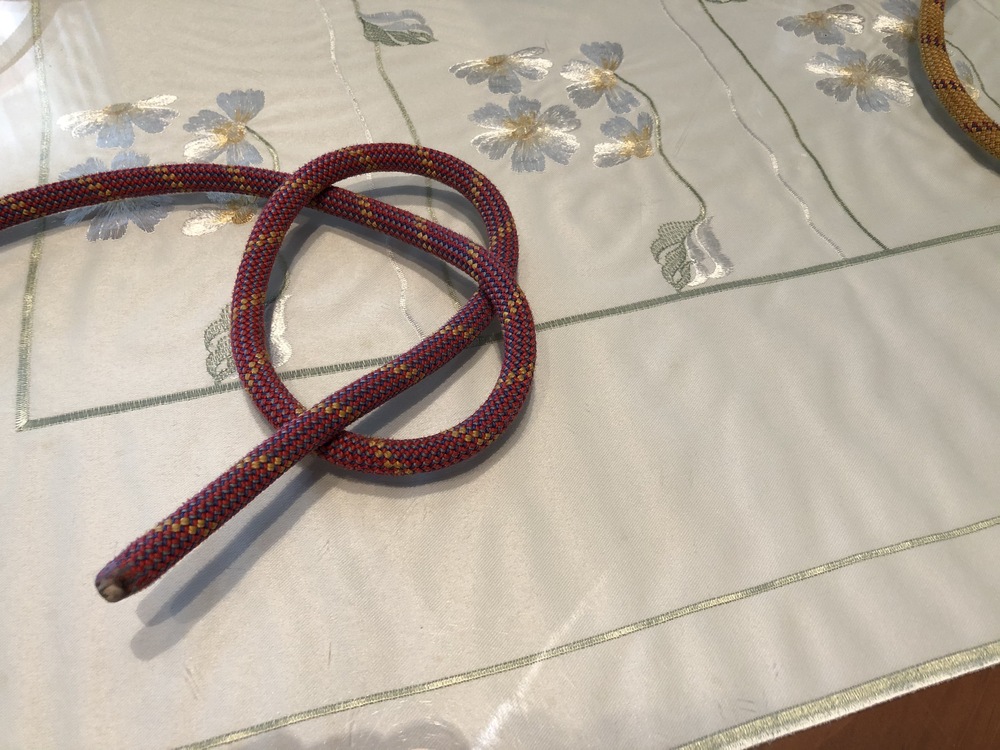 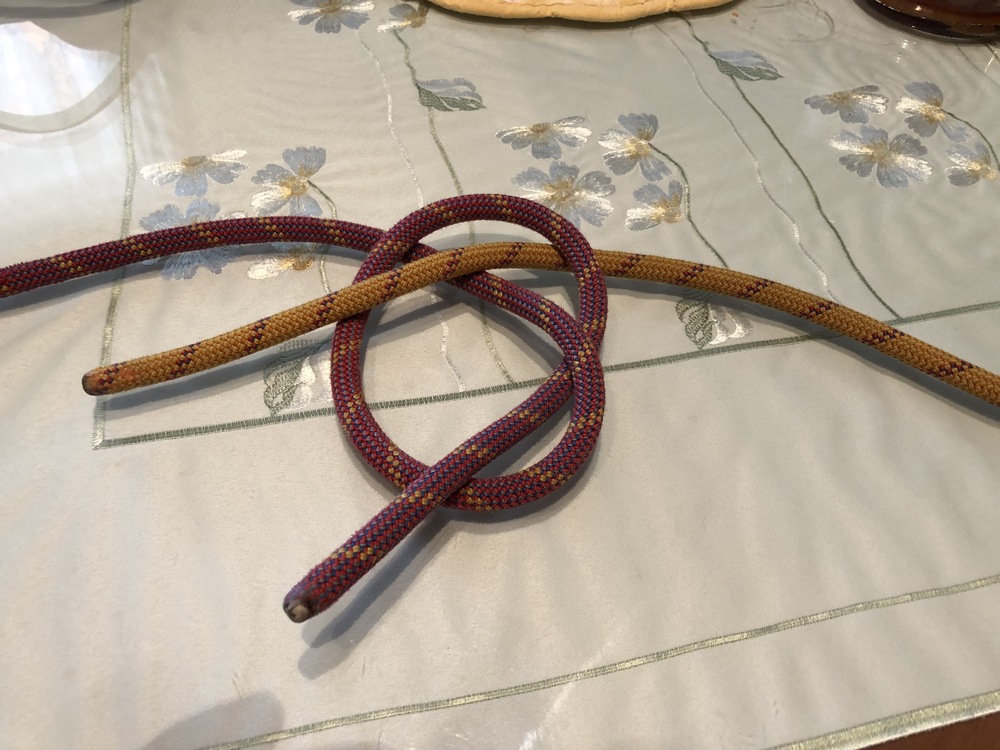 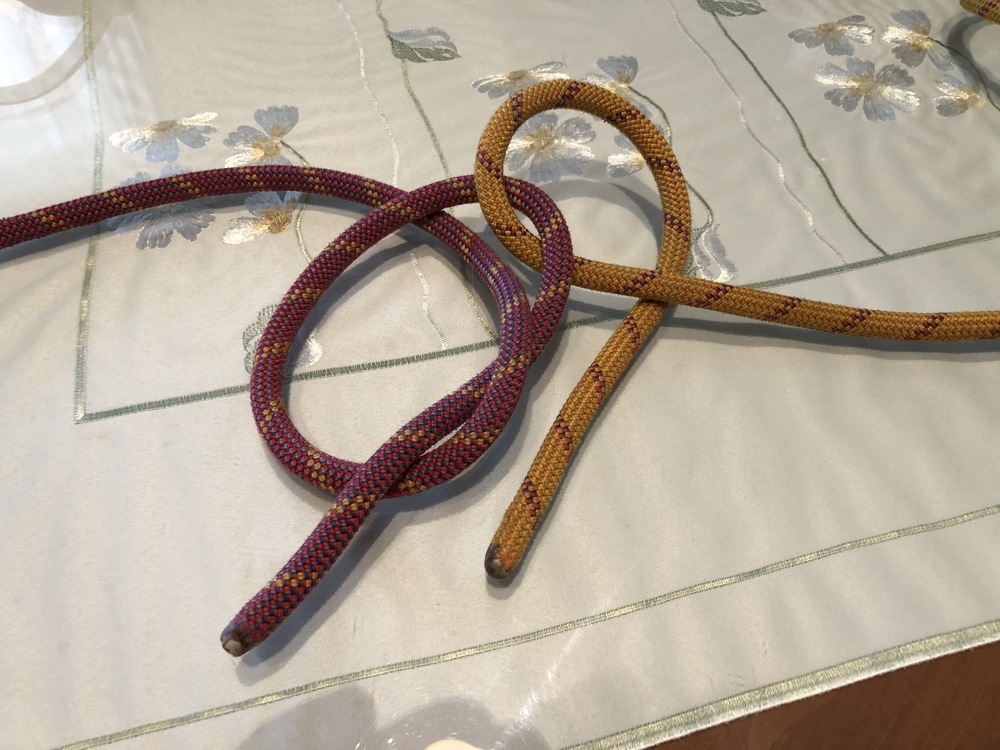 And now reverse trace the way the red tail last passed through the yellow and red strands ... 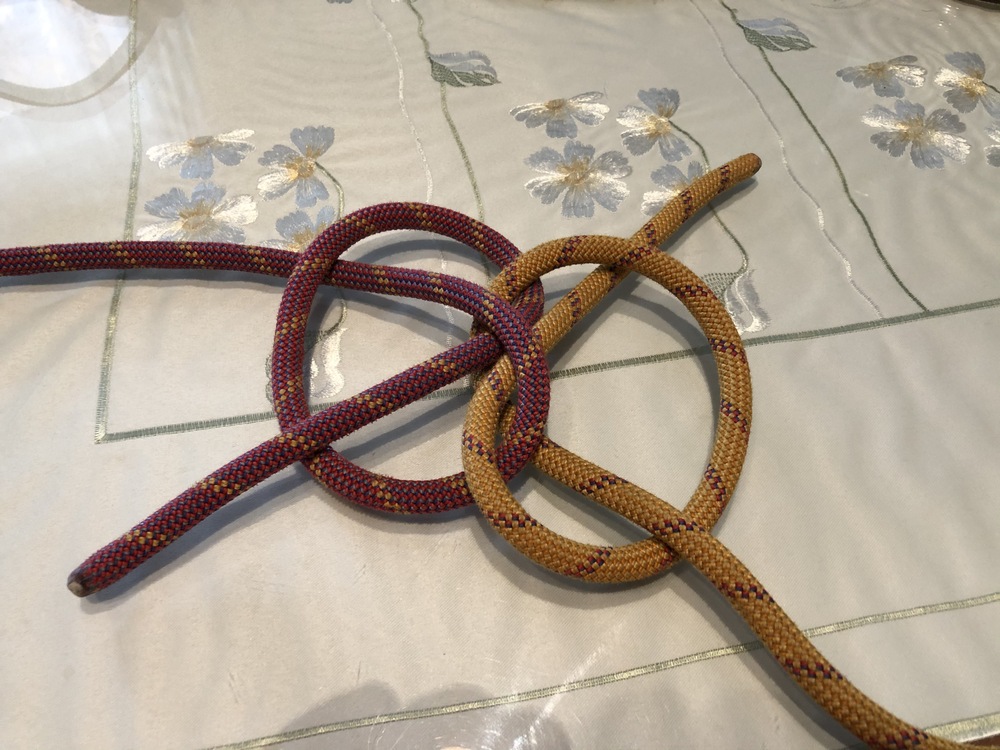 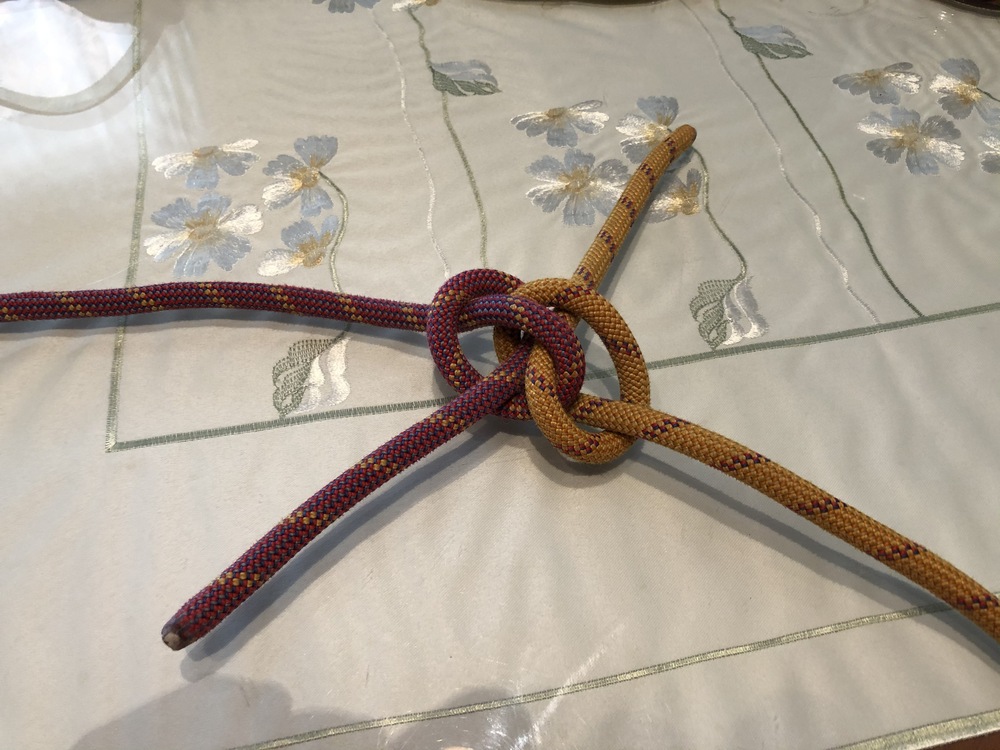 |
|
|
Mark Gommers wrote: Thanks for the link Mark. Very interesting. The ability to adjust the Z-bend in place is an interesting feature that makes me rethink its utility. |
|
|
Most of the value of the cordelette in my mind is that it's pretied and you don't have to tie/untie it ever. I don't buy that the ability to untie is actually a benefit, because if I'm going to tie/untie the knot, then I might as well just build the anchor with rope. So discussion of flemish bends or zeppelin bends has little to do with what I want from a cordelette. Ostensibly, the OP has solved his problem in the 5+ years since he posted the original question, but a solution I'm considering right now: Instead of tying the cordelette as a large loop, tie it as a single strand with pretied loops at the ends. This allows you to build your anchors in a really similar way, with a little over half the cord (more than half, because tying, say, figure 8 loops at the ends takes up more rope than the bends you would use to create a loop). This is similar to something I saw in an old Hans Florine video, and it's clearly faster than the one-big-loop method (he used it while speed climbing). The only difference was he tied clove hitches at the ends while climbing. The clove hitch has some benefits (mainly, adjustability) but I think overall a pretied loop will be faster and you can adjust by throwing in extra turns at the master point (i.e. tie your BFK with an overhand, figure 8, or figure 9) at which point you have a better idea of how much slack you need to take up anyway. I haven't tried this yet in practice though, so take it with a grain of salt. |
|
|
Per David K’s comment, when tying bite knots on the ends of a coordelette rather than making a loop, the abrasion will always be concentrated in the same spots and I found that my cordelette was becoming core shot on those knots very quickly. Sometimes, just a few days. I liked the method otherwise, but I didn’t enjoy chopping/retiring cordelette so often so I went back to a tied loop. |
|
|
"5.5mm dyneema/spectra core cord from various manufactureres is also very strong and very stiff. " |
|
|
Alex Fletcher wrote: Interesting, makes sense! This is why I gave the caveat that I hadn't actually tried this in practice--sometimes when you actually try out your ideas something like this shows up that you didn't think of. When using a cordelette with a loop, I tend to have the ends at the same spots anyway, because I'm always trying to get the double fisherman's bend out of the way, so that's always positioned near the end, and the wear I get with that method is slow enough that it's acceptable to me. I'm actually using the cordelette with the end loops now, so we'll see how much faster that wears with the cordage I'm using. |
|
|
Alex Fletcher wrote: The webolette probably won't develop abrasion spots like cord will, right? Lighter and less bulky than cord, too. 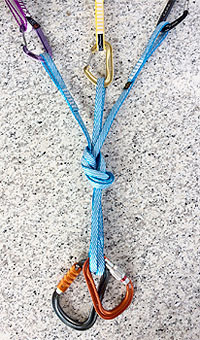 |
|
|
Something to keep in mind with webolette/snake-cord anchors is that you only have one strand going to the outside pieces. Throw in strength reduction from a terminating knot on a snake cord and you might have 1/3 the arm strength relative to a loop. Of course, 1/3 might still be plenty. A compensating factor might be that the longer, single strand arms will probably receive less of the load (assuming the center piece holds). |
|
|
I like a 240 cm dyneema as a cordalette. It weighs almost nothing and I haven’t died yet. It’s especially great in the alpine if I’m trying to save weight. In places like red rock where it’s mostly bolted anchors, I find myself using slings to build anchors most of the time |
|
|
mbk wrote: This a good point and a general reminder that knots reduce strength and we should at least be aware of this when we tie them. Although I thought most knots reduce strength 30-40% opposed to 60+%. With this in mind, this is another great reason to use tech cord rated near 19kn or sewn slings rated even higher, so your safety margins are increased without losing function. |
|
|
Web-o-lette... the sewn instead of knotted ears reduce abrasion, yes, but webbing tends to not be so good with abrasion compared to cord overall. With webbing, the whole thing is structural, with cord you at least have sheath and core. You can get cord with sewn eyes at the ends... but then you give up the benefit of being able to easily untie it. Tradeoffs. You could probably sleeve the knots in tubular webbing to deal with the abrasion issue, but you would add bulk and weight. 1/2" tubular should work, a bit smaller would be better, but not exactly common and probably a pain to thread it. |
|
|
Demetri V wrote: Yeah, I would like to see the data on improvements over the years. I don't know if the manufacture would be a great source because of possibly different test methods from manufactures to manufactures and source bias. It would be nice it this test that was shared earlier in this thread was repeated. user.xmission.com/~tmoyer/t… |


