
 Continue with onX Maps
 Sign in with Facebook






Do Grivel crampons lose their edge fast or is it me?


|
|
I bought a pair of semmi-auto 12-point Grivels last year and used them until they were worn down to a nice soft nickel-ish edge. About two weeks ago I sharpened them up and did a little light hill-walking in them this weekend. I walked on a few dozen meters worth of granite in them. I got back to the car, looked at the things, and the edge I put on is completely gone. When I got home I looked at my old BD strap-ons and noticed that despite being used hard they're still much sharper than the Grivels ever were; they seem to be made out of a better steel. Has anyone else found this to be the case? I need to trust these sucks with my life. |


|
Grivel has some of the best steel around. Depends what kind you have but the more you sharpen them the more they will wear down. Sharp points do not last as long as dull points. Not saying to never sharpen them or anything like that |
|
|
Artem Vasilyev wrote: My assumption would be that a softer steel alloy may be advantageous by weight but compromises in terms of longevity (needs more maintenance). Don't assume. Steel is all the same density (within a couple percent), regardless of alloy. In addition, while alloy is one factor in longevity, heat treatment is just as important (and also does not significantly affect density). There is no appreciable weight difference between any type of steel crampon resulting from material choice. |
|
|
Artem Vasilyev wrote: What is the weight difference between the two sets of crampons? Is it drastic? My assumption would be that a softer steel alloy may be advantageous by weight but compromises in terms of longevity (needs more maintenance). But I am not a materials science person - so I'm curious to see these responses. Ironically steel alloys are marginally lighter the stronger they get. The elements used are lighter than iron which is the base element. |
|
|
https://www.google.com/search?q=density+of+steel The density of steel varies based on the alloying constituents but usually ranges between 7,750 and 8,050 kg/m3 (484 and 503 lb/cu ft), or 7.75 and 8.05 g/cm3 (4.48 and 4.65 oz/cu in). |
|
|
rocknice2 wrote: I disagree with this vast oversimplification with how steel alloys work. Example: M2 tool steel is (very slightly) denser that 4140, and yet significantly stronger*. 4130 is the same density or slightly lighter than 1020, and yet stronger*. |
|
|
Kyle Tarry wrote: It was an oversimplification. |
|
|
Here are some pictures. The two sets were used about equally hard (not that hard). I've never sharpened the BDs. 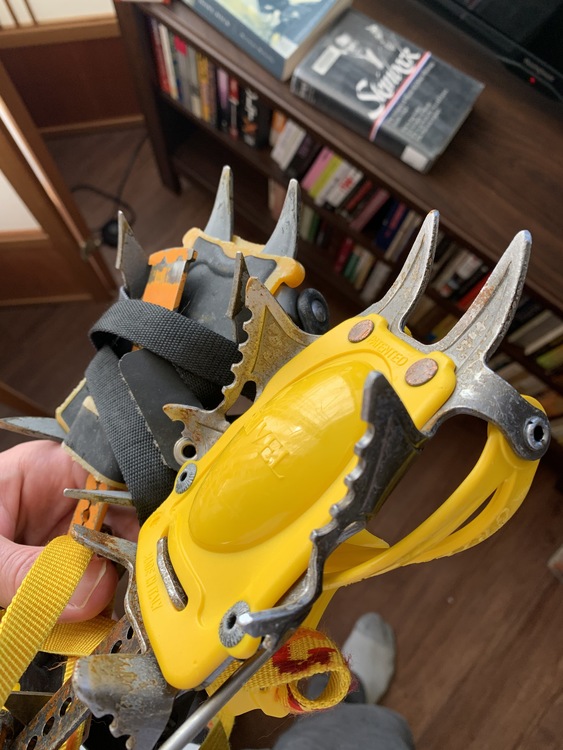 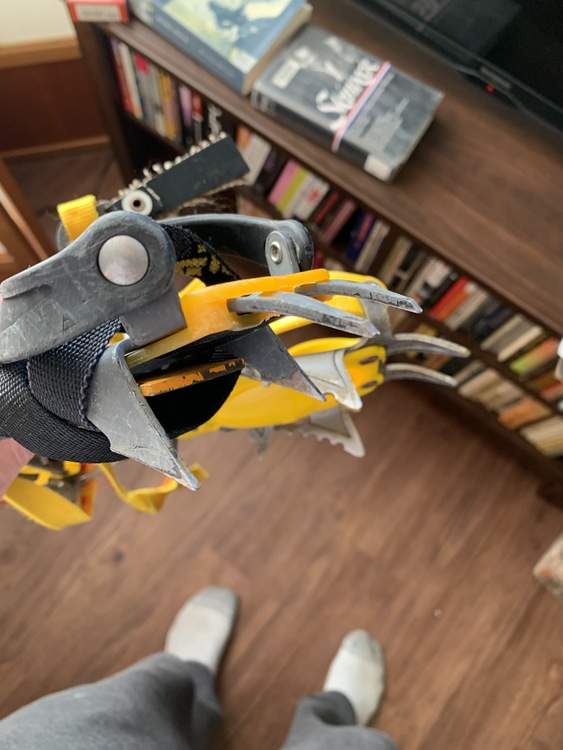 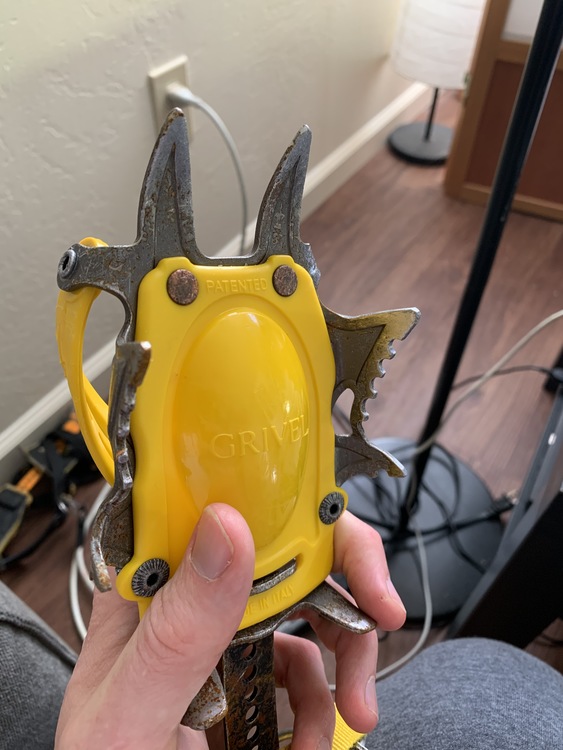 |
|
|
YOLOLZ Bicarbonate wrote: Here are some pictures. The two sets were used about equally hard (not that hard). I've never sharpened the BDs. Did you sharpen the front points from the side? Like a pencil point? Horizontals need to be sharpened like a chisel, from the top. |
|
|
Artem Vasilyev wrote: https://www.wasatchsteel.com/hardness-vs-toughness-vs-strength/ It’s kinda complicated. High hardness helps retain an edge, but can reduce toughness and cause problems with brittle failure. Crampons need a blend because staying sharp isn’t the only concern (actually it’s likely not even the most important one). Plus, corrosion resistance is a completely independent variable, which some brands are more concerned with than others. Edit: the rock's hardness is only one part of the puzzle. A very hard but very smooth rock, for example some andesites, would likely not cause much crampon wear. A granite with a lot of surface texture and crystals might cause more wear, even if it's slightly less hard. The usage is really important too; precise placement of crampons onto holds isn't going to cause a lot of wear, but scraping, sliding, or walking on rock in crampons will. |
|
|
rocknice2 wrote: Did you sharpen the front points from the side? Like a pencil point? Horizontals need to be sharpened like a chisel, from the top. I did sharpen them from the sides. I'll try again from the top and bottom next time. |
|
|
Odd. I work in ‘pons on average 150-200 days a year and my BD’s all wear out before my Grivel’s. Ymmv. |
|
|
YOLOLZ Bicarbonate wrote: Top only! You can narrow them from the sides but not to a point. |
|
|
Higher carbon steels will be harder and stronger but also more brittle. Hardness refers to a materials ability to resist deformation, ie hold a sharp edge in this application. Heat treatments allow for a lot of different crystal microstructures within the steel. For example, quenching steel in a water bath (dropping it from the austenite phase to below ~100 degrees Celcius very quickly) produces a crystal structure called martensite. I would imagine martensite is ideal for crampons (ignoring corrosion) because it is both ductile and strong, so it will hold an edge and also be less likely to fracture/break. Cooling steel at different rates produces different microstructures, for example, with the right carbon content, slow cooling will produce pearlite, which is not as strong as martensite. The qualities of steel can also be changed with cold working and annealing. Cold working basically means deforming the metal, which adds dislocations to the material, increasing hardness and strength, while reducing ductility. Annealing involves bringing the material to a particular temperature (generally 300 ~ 500 degrees Celcius for steel), and holding it there for a bit. Annealing increases the grain size of the material's crystals and removes dislocations, thereby making the material more soft and ductile. 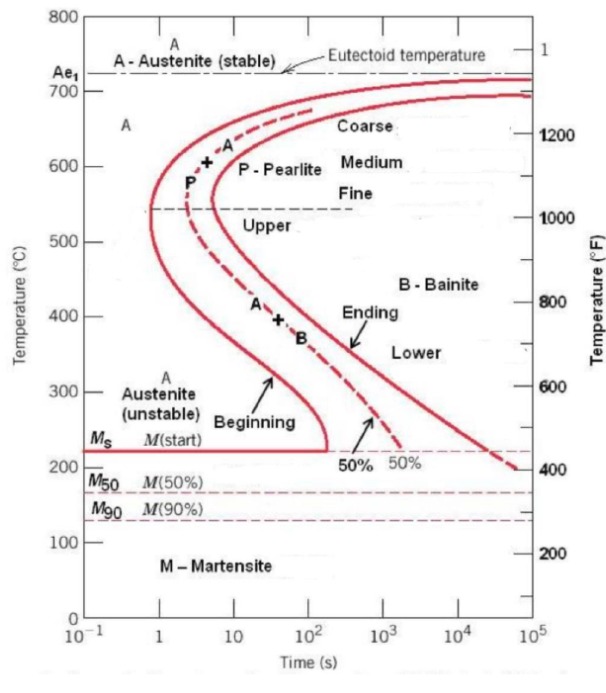 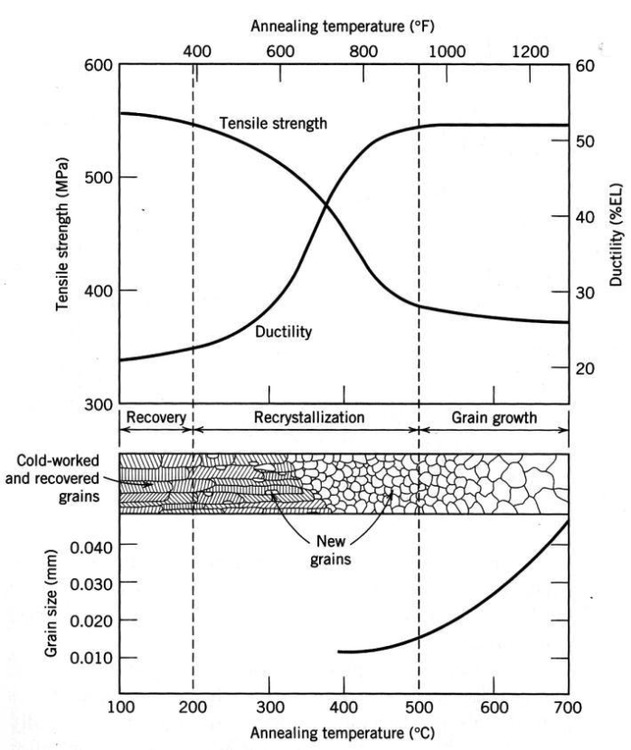 I am by no means an expert or a materials engineer, but figured this was a good opportunity to use the share my limited knowledge from the few materials engineering classes I have taken. Hope you enjoyed! |
|
|
Good info in this post! I'd make a few small additional points: Jack Waeschle wrote: Higher carbon steels will be harder and stronger but also more brittle. Sort of! It's not just the carbon content that matters, but other alloying elements, and also heat treatment. One of the main benefits is that higher carbon content allows for achieving higher strength and hardness through heat treatment. Higher carbon content may reduce ductility though. Hardness refers to a materials ability to resist deformation, ie hold a sharp edge in this application. I totally agree that hardness will help a crampon hold an edge. It's worth noting that, for those who aren't familiar with material behavior, that hardness refers to the ability to resist a very specific type of localized deformation, and not a general increase in the materials "stiffness" or "elasticity." Common hardness tests refer to resistance to scratching (Vickers) or indentation from a very small diameter tip (Rockwell). What is counter-intuitive is that hardness does not effect the bulk elasticity of the steel, meaning that it takes the same force to, for example, stretch or bend the overall crampon regardless of hardness. I would imagine martensite is ideal for crampons (ignoring corrosion) because it is both ductile and strong, so it will hold an edge and also be less likely to fracture/break. I don't think this is true, although I am definitely approaching the limit of my materials science knowledge here. A quenched and fully martensitic steel is likely to be quite hard and brittle. For example, this source says "Martensite is very brittle and can not be used directly after quench for any application." You'd need to temper it to make it useable. Even products where hardness is more desirable above all else that crampons (such as tooling) will be tempered somewhat and not left in the as-quenched martensite state. The 39NiCrMo3 steel alloy C.A.M.P. has traditionally used for its crampons and axes has a tensile strength of 1180 N/mm^2 and a hardness of HRC 42-44 (source) (Note: 39NiCrMo3 is AISI 9840, which is very similar to 4140 in composition. A hardness of 42-44 HRC is very moderate, 4140 is capable of achieving a much higher hardness than this so it demonstrates the compromise between hardness and ductility that is desirable.) BD has some good info related to crampon design and failure here: https://www.blackdiamondequipment.com/en_US/qc-lab-gear-doesnt-last-forever--crampons.html |
|
|
bevans wrote: Odd. I work in ‘pons on average 150-200 days a year and my BD’s all wear out before my Grivel’s. Ymmv. Careful. The OP appears to be comparing some of the older BD chromoly crampons with modern Grivel. For the last 6-8 years BD has been using stainless steel for crampons which are much less durable. |
|
|
Thanks alpinejason. Good point. I had missed the photos the OP followed up with. |
|
|
alpinejason wrote: These are the older models I believe. They didn't come with ABS plates and I had to find them online, which proved difficult because they don't make the particular design anymore. I did get a pair eventually though. |
|
|
Kyle Tarry wrote: A quenched and fully martensitic steel is likely to be quite hard and brittle. For example, this source says "Martensite is very brittle and can not be used directly after quench for any application." You'd need to temper it to make it useable. Even products where hardness is more desirable above all else that crampons (such as tooling) will be tempered somewhat and not left in the as-quenched martensite state. Oh I totally agree. Now that I think about it, in lab our strongest steel that was still ductile was martensite that we annealed after quenching. |
|
|
YOLOLZ Bicarbonate wrote: Here are some pictures. The two sets were used about equally hard (not that hard). I've never sharpened the BDs. Are these not the Aluminium version Air Tech? There is a steel and and lighter Alu version for ultralight and ski touring use. I believe the main visual difference is the lighter grey coloured points compared to the darker colour of the steel version (could be wrong on this, but I’ve nearly bought the aluminium ones previously and they were lighter grey than the steel version) |
|
|
Echo Echo wrote: No, definitely steel. They weigh enough. |


