
 Continue with onX Maps
 Sign in with Facebook






R value of rope/backpack



|
Anyone have a guess about R value of rope and or a backpack? I thinking about folding my sleeping pad in half to double the R value and putting a bag under my feet, for winter/alpine weight savings. |
|
|
Between, "better than nothing" and, "0". |
|
|
Justin Veenhuis wrote: I thinking about folding my sleeping pad in half to double the R value pretty sure R values are not linear....meaning twice the thickness doesn't result in twice the insulating properties... just carry a pad, you're gonna be more comfortable. one thing I've learned as I've aged, don't trade weight savings for your sleeping comfort (within reason). it ain't worth it. |
|
|
curt86iroc wrote: R value is linear R-1 is equal to the insulation value of 1 inch thickness of a soft wood such as pine R-2 is 2 inches etc. |
|
|
Stuff like that is for unplanned nights out. I'd be disappointed in a partner if they showed up to do a multi-day outing intentionally ill-prepared, and ended up dragging ass all day because of it. |
|
|
This is all great input. Exactly what I was looking for. |
|
|
I've spent a long night sleeping on a rope and some ferns, in a 60degree liner, cuddling with a friend wrapped in a emergency blanket. Long Ranger is correct, its between "better than nothing" and "0". Strangely enough, the whiskey may have had a higher "r" value, so to speak. |
|
|
Careful with the booze on a cold night. Alcohol is a vasodilator and will lower your core temp. |
|
|
I often use a rope pillow and a backpack under my feet, either with a half ridge-rest or short thermarest; I find my feet are usually hot in the toe box of my sleeping bag, so I don't miss the extra half-pad. If things are colder than I expect, I'm curled up on the half-length of genuine pad. Some packs, like the old Wild Country Andinistas have a foam insert as part of the suspension system, which makes your pack extra comfy for your toes in the cold. Avoid taking this insert out to sleep; trying to put it back in the pack as part of an alpine start is folly. Of course your mileage may vary, so test things out before you're pissing your partner off by bailing before you even get out of the tent... |
|
|
chris21 wrote: No, it’s not linear. As you add thickness, the thermal conductivity curve flattens meaning there is a point where adding additional insulation yields virtually no change in heat transfer through the material...thus providing no additional insulation. 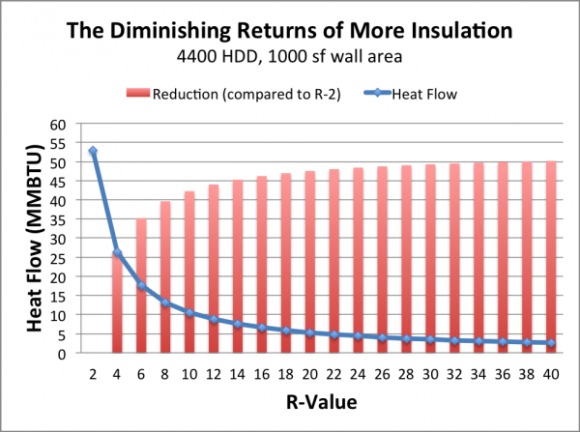 |
|
|
I've used a rope as a blanket, and yes, as others have iterated above... not very good! |
|
|
curt86iroc wrote: Heat transfer is not linear, I didn't say it was. R value is linear(it is one axis of your graph). It is a measurement that compares heat transfer through an insulator to the thickness of wood that allows the same transfer. R-1= 1inch of wood R-49= 49inches of wood. |
|
|
im sorry but no it's not. R-value is a calculated value with units that in no way relates to wood (wood HAS an R-value, but it does not define the scale). take a gander: https://en.wikipedia.org/wiki/R-value_(insulation) |
|
|
curt86iroc wrote: You keep repeating this, but it's not true, and the material you link to states this. R-values in series (and in fact series resistance values of any kind) are simply added together to get total system resistance. This is fundamental heat transfer or electrical engineering 101. Here are direct quotes from the wikipedia article you linked: As long as the materials involved are dense solids in direct mutual contact,[9] R-values are additive; for example, the total R-value of a barrier composed of several layers of material is the sum of the R-values of the individual layers. Increasing the thickness of an insulating layer increases the thermal resistance. For example, doubling the thickness of fiberglass batting will double its R-value Like resistance in electrical circuits, increasing the physical length (for insulation, thickness) of a resistive element, such as graphite for example, increases the resistance linearly; double the thickness of a layer means double the R-value and half the heat transfer; quadruple, quarters; etc. Here's another reference from the DOE: https://www.energy.gov/energysaver/weatherize/insulation When calculating the R-value of a multilayered installation, add the R-values of the individual layers. (Caveat: These are all generalizations of insulation, and no generalization even holds up exactly under real-world conditions. This is especially true with thermal resistance, since there are multiple mechanisms of heat transfer and the barriers to these take very different forms. Nonetheless, they are useful approximations, and the approximation that 2 equal resistors in series has 2X the resistance is widely accepted). |
|
|
Enough with the cited sources, lets bring out the personal attacks! |
|
|
Planning to use you rope as a pad is a bad idea. Even dry treated ropes can retain moister which will then be transferred to your bag. Depending on the conditions and climbing this is just not the ideal setup. Just my 2 cents ...................................good for emergencys |
|
|
Kyle Tarry wrote: im not arguing that in theory you can add r-values together on paper. im arguing this isnt true in the real world, as you pointed out. take off your engineering 101 hat off and look at some data like the initial graph i posted. yes, you can use very VERY basic circuits to model HT at a student level (any engineer can do this), but don't think this translates into the real world where people do this for a living. go work in a lab or organization that studies complex HT and bring up circuit modeling...you'll get laughed out of a job...or probably an introduction into computer modeling at least. and no, your last point of 2x resistance being widely accepted is not true (ok, maybe it is in simple industries like building materials,). in mine we base thermal properties off actual real world data and not theoretical models. heat transfer is complex and matching scenario based modeling to real world results is often very difficult. even after an initial model is presented and an experiment is run to confirm the results, many times the model cannot be made to represent the findings. |
|
|
I theorize that two inch of backpack and 2 inch of rope isn’t R value of 4. |
|
|
Andrew Poet wrote: Enough with the cited sources, lets bring out the personal attacks! This turned out to be pretty prophetic. Keep it classy, Curt! |

|
Sophia Lin wrote: I've used a rope as a blanket, and yes, as others have iterated above... not very good! You are better off using the rope as a pad rather than a blanket. The ground can sink much more heat than air. |
|
|
curt86iroc wrote: Neither of you are wrong. If you double the thickness you double the R value. But doubling the R value doesn't give you twice the energy efficiency or cut heat loss in half -- with insulation for example you can go from r8 to r15 but your only reducing heat loss by 5% or so. In other words you can have twice as much rope to sleep on (and twice the R value) but its not going to cut the heat loss from your body in half. The bigger question in a scenario like this is what the initial R value of your rope/backpack. If it is R1 or R2, doubling it will make a huge difference. If it is already at R5, you wont feel too much of a difference in most scenarios. |


