|
|
Mike Slavens
·
Jun 21, 2017
·
Houston, TX
· Joined Jan 2009
· Points: 35
Nate Ball wrote:... are these bolts an imminent risk for failure from SCC? How can we make a determination either way?
Pull testing them, or Jim's torque testing, is actually a good method for determining if they have been affected by SCC in this case. Pull or torque them to 70% - 80% of rating. If they don't fail then it is extremely unlikely they have been affected by SCC. There is also a good chance you would see the cracks open up when stressing the bolt that high. For SCC to be effecting a part it has to be under constant tensile stress. In the case of climbing bolts either residual stress from bending it to shape, or the tension you put on the shaft in a mechanical bolt during installation. In other words, the stress to fail the bolt or hanger would have already been there for the 10 years of service and would have already significantly weakened the bolt due to SCC if the bolt was prone to SCC. In industry you don't design for an allowable amount of SCC like you do for general corrosion. For general corrosion it is typical to test and design for an allowable corrosion rate. Say 1mm/yr metal loss. If a piece of equipment has a 30 yr service life and I can tolerate 50mm of metal loss before the loads would exceed the reduced strength rating then 1mm/yr loss is acceptable. For SCC, you design it out entirely. The testing protocol (ASTM) for SCC typically revolves around stressing a metal sample to 90% or 100% yield strength (4 pt bend test for example) and exposing it for 30 to 90 days to an environment slightly worse than expected (high chloride concentration, low pH). If even a single crack starts to form (examined with a microscope) then the sample failed and would not be rated for SCC in that service. If no cracks form then it would indicate the sample isn't susceptible to SCC in that environment. Not sure if this last paragraph adds to the conversation but there are quite well established industry standards for determining if a metal is rated for SCC service. However they would be very impractical and expensive for a single climber or even a small climbing organization to pursue.
|
|
|
Nate Ball
 ·
Jun 21, 2017
·
Unknown Hometown
· Joined Aug 2010
· Points: 13,491
·
Jun 21, 2017
·
Unknown Hometown
· Joined Aug 2010
· Points: 13,491
If they don't fail then it is extremely unlikely they have been affected by SCC. There is also a good chance you would see the cracks open up when stressing the bolt that high. What you're missing here is that failure only means that the SCC has advanced to the propagation stage, in which crack growth rate is increasing exponentially. Cracks would not "open up" because the temporary force you're applying is insignificant relative to the constant internal stresses (which ALL bolts have), which are the primary driver of crack growth. Each bolt is subject to varying micro-climates, and thus just because one bolt fails doesn't mean that others nearby aren't going to fail in a year or twenty or somewhere in between. The opposite is also true - just because a bolt doesn't fail now doesn't mean it won't fail in a week, or a year, or ten.
316ss is obviously not immune to SCC at ambient temperatures. This is known. So... how long until you replace them?
|
|
|
wojtek gierlotka
·
Jun 21, 2017
·
Unknown Hometown
· Joined Jun 2017
· Points: 0
I don't want to be impolite , but metallurgy is a bit more than googling information in the Internet. You wrote: "crack growth rate is increasing exponentially". Exp is a function of some variable. What's variable in this case? The failure of tested bolt means only that area was not big enough. Nothing less, nothing more. To tell anything else you have to make metallurgical analysis. BTW, please, correct the information from your previous post about failure of 316 bolts in LD. There was no failure of 316 bolt in Long Dong so far. There are only 3 kind of 316 glued-in bolts in LD: a) 1st set of Taiwan made (installed in 2004), b)Fixe 316 (installed in 2011-2012), c)2nd set of Taiwan made (installed since 2012). All types of not glued-in bolts in Long Dong were advised as not trustworthy since 2006 (M.Robertson "Long Dong, 101 Trad Climbs"). cheers w.
|
|
|
Nate Ball
·
Jun 21, 2017
·
Unknown Hometown
· Joined Aug 2010
· Points: 13,491
Wojtek, you're a very impolite person, but no need to worry about that on the internet, especially in MP forums. I've done plenty more than Google information and rely on what you've told me in the past. I can link you to SCC crack growth curve graphs if you like, but I'm sure you're capable of finding them yourself.
You said "to tell anything else you have to make metallurgical analysis." Can you tell us how we might be able to do this in situ or would the fixing have to be removed, and thus replaced, to do so?
I've done my best to not post anything non-factual. It turns out, in spite of what you told me previously, that the Petzl P38 LongLife bolts were 316ss. These have been considered "not trustworthy" by some people, including Matt, since a failure resulting in severe injury in 2003. However, many of these were left in place until as late as 2014, after several failures that included another severe injury in 2012.
|
|
|
billnye
·
Jun 21, 2017
·
Unknown Hometown
· Joined Oct 2016
· Points: 0
Nate Ball wrote:I... think I have a fairly well-founded understanding of the situation.... Clearly not. Like an anti-vaxxer, your substitution of real science for internet- or anecdote-based pseudoscience is obvious to everyone, except perhaps yourself. Of the actual scientists you claim to have learned from, it's plainly obvious that you cherrypick facts. Even your word choice and grammar show your lack of seriousness about the facts, compared with your clear desire to be taken as an "expert" by reflexively disparaging or disagreeing with those who are truly knowledgable about this subject. If you had any genuine concern about the metallurgy of bolts, then you would know that an online forum isn't really the place to solicit informed insight. While I can change my brake pads, Ford isn't posting on my car forum for advice on brake design. But if you want to try to look like an expert among climbers, who often habitually self-identify as "engineers" , you picked the right spot. But even here on MP, you've been called out. Though you intended it as a statement, the title you chose for this thread reads much more like a question. And you can save the comeback; I already know that I'm a "very impolite person." :)
|
|
|
Nate Ball
·
Jun 21, 2017
·
Unknown Hometown
· Joined Aug 2010
· Points: 13,491
Thanks for crawling out of the woodwork to bring real light to this topic! Perhaps you'd like to go a step further and actually clarify any of the pseudo-science that this thread has been spreading?
|
|
|
20 kN
·
Jun 21, 2017
·
Unknown Hometown
· Joined Feb 2009
· Points: 1,346
Nate Ball wrote:
.
There are only two bolt types without precedent for failure, and those are welded 316ss glue-ins - both Fixe and a Taiwan-made copy. The majority are in the 10-12 year range. This is what we are discussing... are these bolts an imminent risk for failure from SCC? How can we make a determination either way? If we can't possibly know, then what is the prudent course of action?
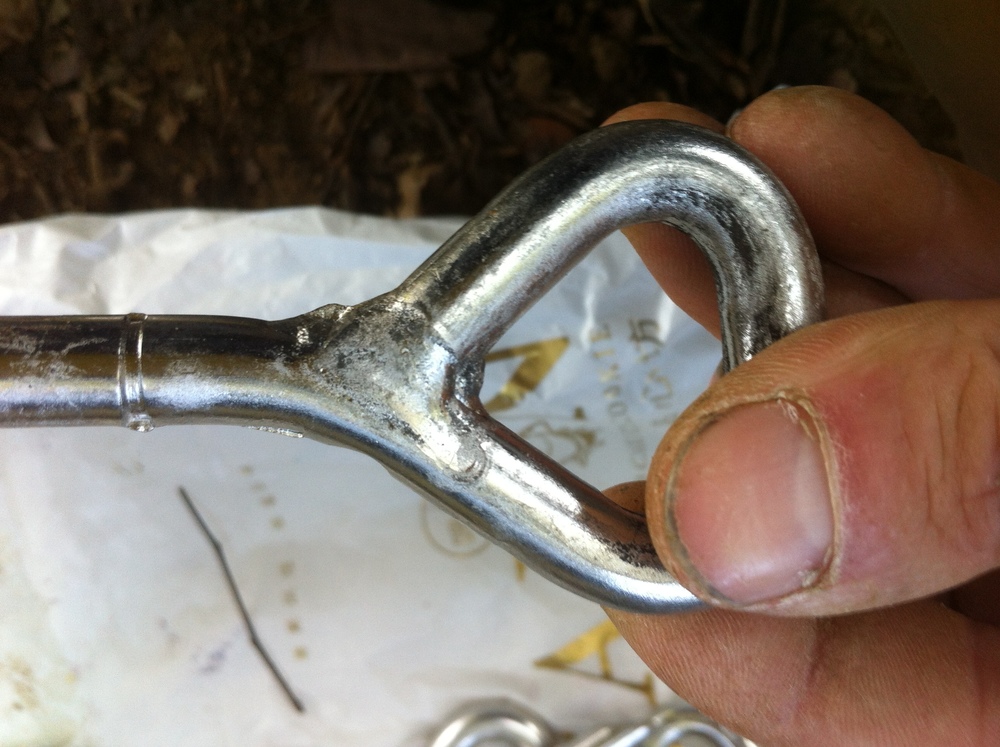
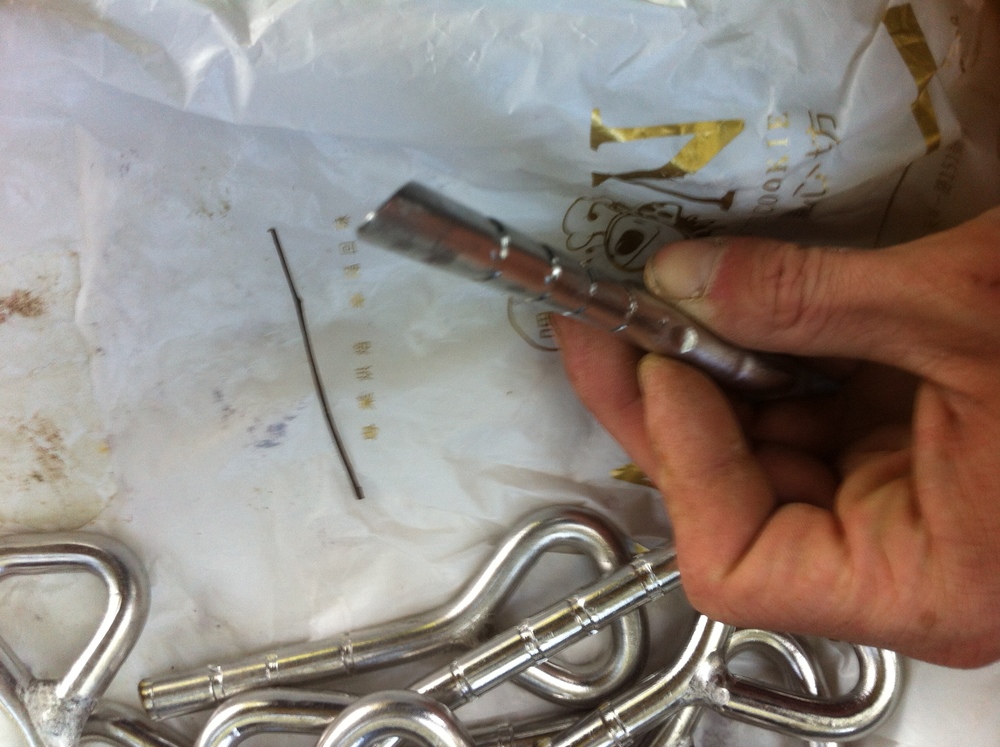
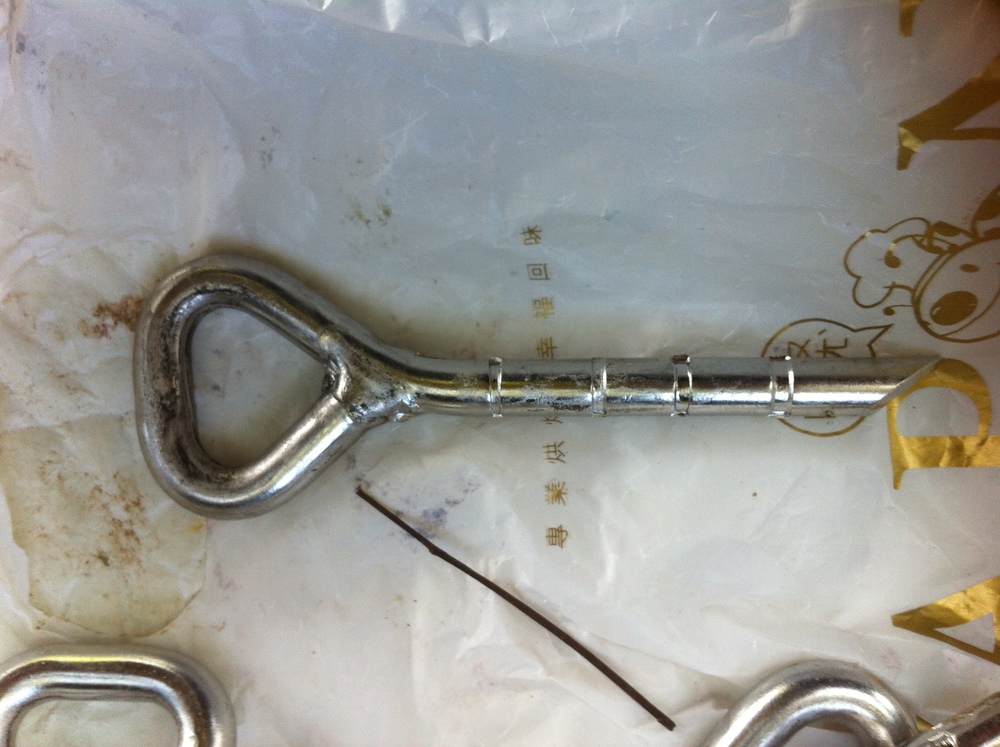
Here are some pics of the TW-made 316ss bolts pre-installation:
Unrelated, that's some pretty shaky manufacturing quality. Some of those bolts in the photos only have three shallow rungs for the epoxy to key into which is very borderline. I would not feel comfortable installing those without threading the ends to make sure the epoxy actually has something to hold onto. I've seen cases of bolts with more keying on them than shown in this photo pull from their placements with the epoxy left bonded to the base material. As such, the lack of manufacturing QC brings into question the QC of the alloy. In any case, I've seen several of other manufacturer's version of that bolt in fail from SCC right at the weld. Typically when they start to crack they do so just under the epoxy layer, right at the weld. The crappy thing is the bolt itself can look perfectly fine visually, even under close inspection, but it’s not because the SCC occurs where you cannot see. When you start to get failures, that might be where they will happen.
Mike Slavens wrote: Pull or torque them to 70% - 80% of rating. If they don't fail then it is extremely unlikely they have been affected by SCC. There is also a good chance you would see the cracks open up when stressing the bolt that high.
Which would also destroy the placement thus rendering the test pointless anyway. I think the idea was to test them with the intent to keep them in service if they pass. If you pull those bolts to 30kN+ you're going to bend them to crap, draw them from the placement and create a bolt that may have been safe originally but now is physically damaged and in immediate need of replacement. Generally proof loading is done up to the yield strength of the material, but at highest no more than 30-40% UTS of the material. CM proof loads their shackles to 150% SWL, which ends up being about 30% of failure strength. I think Metolius does 1/3rd or 1/2 rated strength (which is lower than breaking strength), so it comes out to around 30-40% failure strength. I wouldent go higher than that.
|
|
|
Nate Ball
·
Jun 21, 2017
·
Unknown Hometown
· Joined Aug 2010
· Points: 13,491
Not sure if I explained the local team's testing methodology, so here it is again: each bolt gets loaded five times, cranking it to 12kn, holding it for a minute, then releasing and testing four more times. Apparently this is some kind of "standard" for checking if a material has been stress fractured, but given that this isn't a concern - nor even related - it seems like an unnecessarily time-consuming procedure that provides zero data.
I have also voiced concern about the quality of the Taiwan-made bolts, but obviously these have fallen on deaf ears. With no precedent for failure yet, there seems to be no interest in looking into this, especially given the pride the "team" has for their locally-made products.
|
|
|
20 kN
·
Jun 21, 2017
·
Unknown Hometown
· Joined Feb 2009
· Points: 1,346
Nate Ball wrote:Not sure if I explained the local team's testing methodology, so here it is again: each bolt gets loaded five times, cranking it to 12kn, holding it for a minute, then releasing and testing four more times. Apparently this is some kind of "standard" for checking if a material has been stress fractured, but given that this isn't a concern - nor even related - it seems like an unnecessarily time-consuming procedure that provides zero data.
I have also voiced concern about the quality of the Taiwan-made bolts, but obviously these have fallen on deaf ears. With no precedent for failure yet, there seems to be no interest in looking into this, especially given the pride the "team" has for their locally-made products. I'd skip the five cycles and just do it once. Adding in four more cycles is very unlikely to fatigue the stainless steel enough for the SCC to cause failure where it would have not with one cycle. There is also no need to hold it for a minute if you're primary function is testing for SCC. SCC does not creep with load duration, at least not within a minute anyway. Load it to 12kN and as soon as the gauge says you're there, release, inspect and move on. Of course, again the problem with the inspection is if SCC is occurring in those types of bolts, it's likely occurring where you cant visually see it anyway. However, at least you could say that on that day the bolt was strong enough to hold 12kN, and then in six months again the question comes up again. If they are going to go through the exceptional trouble of testing all this stuff, I'd still say the easiest way to get the job done is with a large 4lb sledge and a solid funkness cable. You could test a whole route in a short period doing it that way and still produce at least 8kN with a solid swing.
I am curious how they are testing the anchor. Hopefully not while also hanging on it?
|
|
|
Jim Titt
·
Jun 22, 2017
·
Germany
· Joined Nov 2009
· Points: 490
Mike Slavens wrote:Pull testing them, or Jim's torque testing, is actually a good method for determining if they have been affected by SCC in this case. Pull or torque them to 70% - 80% of rating. If they don't fail then it is extremely unlikely they have been affected by SCC. There is also a good chance you would see the cracks open up when stressing the bolt that high. Not sure if this last paragraph adds to the conversation but there are quite well established industry standards for determining if a metal is rated for SCC service. However they would be very impractical and expensive for a single climber or even a small climbing organization to pursue. Pull or torque testing to 70% or 80% of a bolts rating means it´s bent beyond usability and looks horrific, once you get past yield they don´t look real pretty! Bolts are only designed not to fail, distortion is expected (the repeat load test for the standard says specifically that the bolt may distort). Particularly axial pull testing leaves them looking very sorry indeed, a typical plate hanger for example has already bent at 2kN. A couple of organisations I work with insisted on yearly proof testing by axial pull to 6kN despite advice to the contrary, they have now abandoned this having screwed up a lot of bolts. The torque test is good as it uses the different characteristics of stainless steel in tension and shear. For the smallest bolt we make which has a single 8mm shaft the usual tensile failure is around 37kN and the torque to failure is ca 75Nm, cut halfway through the tensile failure is 20.2kN and the torque failure 32Nm, cut 2/3rds through it is 7.3kN tensile and 18Nm torque. An intact bolt starts to twist permanently at ca 30Nm which is useful as we can´t achieve this with one hand and a karabiner, if you applied the equivelant force by pull testing the bolt looks horrific. I can get between 15 and 20Nm torque using a larger or HMS style karabiner and depending on twisting inwards or out (and left hand or right). We don´t need to test the SCC characteristics of a material using an ASTM test, the results are readily available. The problem is that the very localised conditions encountered in some areas are not covered by the tests, all one can do is stick them in and see what happens or identify the conditions and then try to work out an accelerated method of testing. The actual ASTM tests are relative, the results aren´t empirical rather they rate one material against another or more generally identify the conditions required for corrosion to start. Even the SCC test for titanium doesn´t cover the conditions experienced.
|
|
|
wojtek gierlotka
·
Jun 22, 2017
·
Unknown Hometown
· Joined Jun 2017
· Points: 0
Nate Ball wrote:Wojtek, you're a very impolite person, but no need to worry about that on the internet, especially in MP forums. I've done plenty more than Google information and rely on what you've told me in the past. I can link you to SCC crack growth curve graphs if you like, but I'm sure you're capable of finding them yourself.
You said "to tell anything else you have to make metallurgical analysis." Can you tell us how we might be able to do this in situ or would the fixing have to be removed, and thus replaced, to do so?
I've done my best to not post anything non-factual. It turns out, in spite of what you told me previously, that the Petzl P38 LongLife bolts were 316ss. These have been considered "not trustworthy" by some people, including Matt, since a failure resulting in severe injury in 2003. However, many of these were left in place until as late as 2014, after several failures that included another severe injury in 2012. Please, show the curve here, but it won't change the fact, that function has at least two variables: one independent and one dependent. If the growth rate is dependent, what is independent? Time? Temperature? pH? or...maybe something else? And please, show references as well. At least, you corrected information about failed bolts. Please, be more correct when you are talking about a situation in LD because a wrong data can give a bad impression. In a case of long-life I wouldn't be sure if the broken bolt AND hanger were made of 316. I remember the talk about Collinox made of 316 which became Collinox made of 304. "Can you tell us how we might be able to do this in situ or would the fixing have to be removed". Yes, I can. But since you "done plenty more than Google information and rely on what you've told me in the past" you should know ;)
|
|
|
Nate Ball
·
Jun 22, 2017
·
Unknown Hometown
· Joined Aug 2010
· Points: 13,491
Wojtek, although you will consider this a cop-out, I really have no interest in arguing about the details of why and how SCC works the way it does. Email Alan Jarvis at the UIAA if you genuinely want to know. My feeling is you just want to argue on the internet. If I have made "less correct" statements then please point them out and I will be happy to correct them.
The point of this thread was to discuss whether 316ss should be replaced immediately or if it could be considered safe for the time being. Obviously it's complicated, but the fact of the matter is 316ss shouldn't have been used in 2011-2013, and yet the opinion of "a metallurgical scientist" - you - was at least part of the justification for its ongoing use. And yet now we can all agree that that was not the best long-term solution. Many of your bolts have already been replaced with titanium, and nobody is grieving the loss.
Regardless of our disagreements, regardless of whether there is or is not a precedent for 316ss failure, what is it you think should be done with the 2005-2007 TW-made 316ss bolts?
|
|
|
芳源 章
·
Jun 22, 2017
·
Unknown Hometown
· Joined Jun 2017
· Points: 0
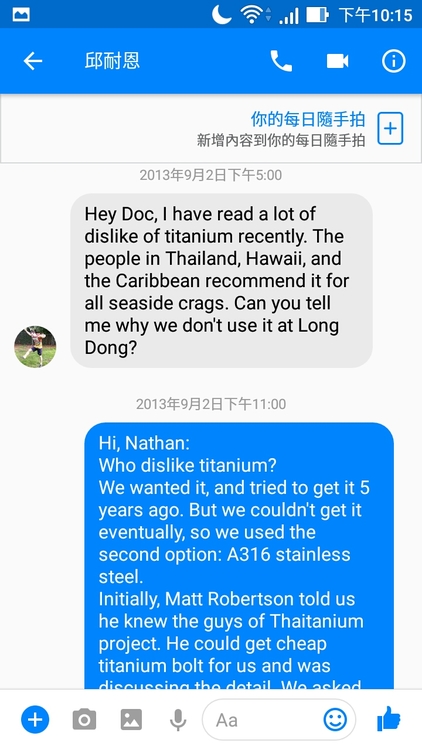
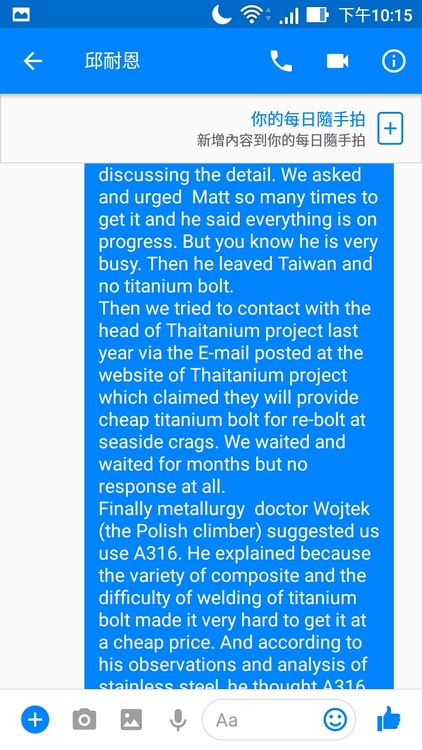
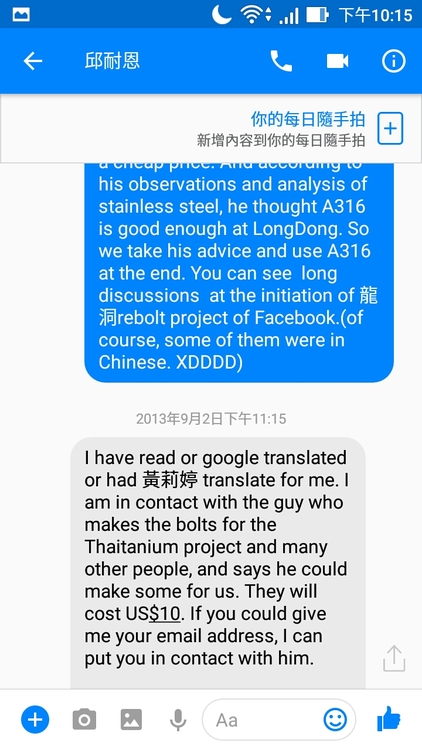
The decision to use 316SS in 2011 at LongDong is the last resort. We tried to buy titanium bolt from Thaitanium Project, but failed eventually. So we have to use 316SS bolt for rebolting rotten Petzl Longlife in 2011. Here is the conversation between Mr. Nate Ball and me , which said the story.
|
|
|
芳源 章
·
Jun 22, 2017
·
Unknown Hometown
· Joined Jun 2017
· Points: 0
|
|
|
芳源 章
·
Jun 22, 2017
·
Unknown Hometown
· Joined Jun 2017
· Points: 0
|
|
|
芳源 章
·
Jun 22, 2017
·
Unknown Hometown
· Joined Jun 2017
· Points: 0
Sorry, l forgot this, 邱耐恩 is the Chinese name of Mr. Nate Ball .
|
|
|
Nate Ball
·
Jun 22, 2017
·
Unknown Hometown
· Joined Aug 2010
· Points: 13,491
This is the Doc, one of the main contributors of the "official" rebolt group. Thanks for joining the conversation. I have a couple questions...
1.) Was Wojtek's justification that "316ss is good enough" the main basis for continuing to use 316ss in 2011?
2.) You were put in touch with Martin at Titan Climbing in 2013 and installed around 30 bolts over the next three years. In 2016, the group produced its own titanium bolts at more than twice the cost per unit (excluding prototype, testing, etc). Can you explain the logic behind this move?
|
|
|
Sam Lightner, Jr.
·
Jun 22, 2017
·
Lander, WY
· Joined Apr 2006
· Points: 2,972
316 will not work. Don't waste the energy and money. Buy Ti. We went down this road and wasted thousands.
|
|
|
Nate Ball
·
Jun 22, 2017
·
Unknown Hometown
· Joined Aug 2010
· Points: 13,491
Hey Sam, how much longer (if at all) did 316 last than 304 in Thailand?
|
|
|
芳源 章
·
Jun 22, 2017
·
Unknown Hometown
· Joined Jun 2017
· Points: 0
Nate Ball wrote:This is the Doc, one of the main contributors of the "official" rebolt group. Thanks for joining the conversation. I have a couple questions...
1.) Was Wojtek's justification that "316ss is good enough" the main basis for continuing to use 316ss in 2011?
2.) You were put in touch with Martin at Titan Climbing in 2013 and installed around 30 bolts over the next three years. In 2016, the group produced its own titanium bolts at more than twice the cost per unit (excluding prototype, testing, etc). Can you explain the logic behind this move? No. Because we couldn't get Titanium bolt, so we had no choice, 316 is the only option at that time . Nate, It's a long story, you knew it very well . Please post the link of LongDong rebolt website. Thanks a lot!
|

 Continue with onX Maps
 Sign in with Facebook