|
|
Nick Sweeney
·
Jun 10, 2016
·
Spokane, WA
· Joined Jun 2013
· Points: 1,032
rgold is dead on. I have a scar on my right hand from catching a leader fall directly on my harness... the skin between my thumb and index finger was pulled into the ATC. If someone falls straight onto your harness, get your brake hand up in anticipation of the belay device flipping over in orientation to the load!
|
|
|
Anonymous
·
Jun 10, 2016
·
Unknown Hometown
· Joined unknown
· Points: 0
I assume that you are referring to the v grooves that add the extra friction.
I was just watching this. Little woman catches f2 fall with a hip belay at 2:20
youtube.com/watch?v=rguTBMw…
|
|
|
rgold
·
Jun 10, 2016
·
Poughkeepsie, NY
· Joined Feb 2008
· Points: 526
Not even close to FF2. More like FF1, plus a good deal of friction over a very rounded edge.
That said, catching FF2's with a hip belay is definitely doable; I had to do it once in real circumstances. I've also caught a score or so of UIAA-intensity practice falls with a concrete weight with a hip belay, since it was conventional to practice such things in the sixties. Much more recently I've caught a UIAA-intensity fall with a Petzl Reverso belay plate.
Forgetting about the practice falls, I've had to catch 2 UIAA-intensity or higher falls in 59 years of climbing. That's pretty infrequent, and it is easy to see how one might get through a climbing career without ever having to do it (I know many people for which that is true). But if you do have to do it, the stakes are high.
People argue with me about this, but my experience suggests overwhelmingly that you want to have gloves on for such big falls.
|
|
|
eli poss
·
Jun 11, 2016
·
SLC
· Joined May 2014
· Points: 525
If I ever risk taking a FF2, I will specifically request that my partner belay me on a munter. That way, when they instinctively bring their brake hand down, they are in the correct braking orientation. On the other hand, I seriously hope that I never have to take or catch a factor 2 fall in the first place.
|
|
|
patto
·
Jun 12, 2016
·
Unknown Hometown
· Joined Jul 2012
· Points: 25
You should never leave the anchor if a FF2 is at all a likelihood. It isn't too hard to remove all risk of a FF2 fall. You just need to have your belayer hand well below the anchor. Clip the anchor and away you go. No FF2 possible.
|
|
|
rgold
·
Jun 12, 2016
·
Poughkeepsie, NY
· Joined Feb 2008
· Points: 526
That's all well and good in theory, but in practice things can be different. Even relatively recently in a pretty conservative stage of my climbing life, I've been in a big FF2 situation because the anchor wasn't great, I didn't want it to be subjected to the much higher forces that would be involved in clipping it, and there was no further protection for a long way. (The break-even point at which the anchor load will be the same whether the belay anchor is clipped or not is extremely close to the belay anchor. Once the leader is above that, clipping the anchor will subject it to higher loads than the FF2.) I warned the leader that if he had the bad judgement to fall, he'd be in for a substantial dynamic belay. As a dinosaur in the climbing world, I'm among the few still standing that know how to do this and have practiced it.
But I've also had perfectly good anchors that were just not suitable for clipping for the leader---typically because the anchors were low and there was no simple way to get the belayer a suitable distance below them. (Sure, you can in principle usually set up a hanging belay below the anchor, and in some cases this is an important strategy, but on long climbs with time pressures or on ledges above overhangs, it can be fully appropriate to opt for holding the FF2.)
Trad climbing, especially in an alpine context but even on sunny crags, is full of "leader must not fall" situations. They are part of the game, and sometimes risking a FF2 fall is part of that game. That being the case, every now and then it will actually happen. Not much, but the probability isn't zero. I think it is best to be fully confident you can hold one when it happens, rather than planning to always avoid it.
|
|
|
patto
·
Jun 12, 2016
·
Unknown Hometown
· Joined Jul 2012
· Points: 25
All quite true. I didn't add the necessary qualifications to my statement.
The amount of times I've done what I've described is 0, the amount of times I've been relieved when my leader gets his/her first piece in off the belay is many.
|
|
|
Anonymous
·
Jun 12, 2016
·
Unknown Hometown
· Joined unknown
· Points: 0
rgold wrote: I warned the leader that if he had the bad judgement to fall, he'd be in for a substantial dynamic belay. As a dinosaur in the climbing world, I'm among the few still standing that know how to do this and have practiced it. But isn't why we use ATCs? Why spend all that money on gear if it doesn't do stuff for us. I can't wait for a portable belay robot to hit the market. Carry and place the gear for me.
I think you are right we associate dynamic belays with using dynamic ropes, ATC or lots of lack in the system and not with controlling the rope during a fall. With most climbers, I usually have to do a quick jump or step forward to give a more dynamic belay. And usually it results in a dirty look from the lead climber. Really annoying because I'm concerned for their safety and them getting them stronger by doing the crux moves again.
|
|
|
Old lady H
·
Jun 12, 2016
·
Boise, ID
· Joined Aug 2015
· Points: 1,375
JulianG wrote: But isn't why we use ATCs? Why spend all that money on gear if it doesn't do stuff for us. I can't wait for a portable belay robot to hit the market. Carry and place the gear for me. I think you are right we associate dynamic belays with using dynamic ropes, ATC or lots of lack in the system and not with controlling the rope during a fall. With most climbers, I usually have to do a quick jump or step forward to give a more dynamic belay. And usually it results in a dirty look from the lead climber. Really annoying because I'm concerned for their safety and them getting them stronger by doing the crux moves again. In rgold's story, I don't see where a jump up would gain enough to do anything, especially if the leader has a good bit of rope out. The jump is right when the rope is about to come tight. And a sketchy anchor?
Reefing in slack like mad when they fall, then dropping it fast?
Rgold???
|
|
|
rgold
·
Jun 12, 2016
·
Poughkeepsie, NY
· Joined Feb 2008
· Points: 526
JulianG wrote: But isn't why we use ATCs? Why spend all that money on gear if it doesn't do stuff for us. You can spend a fortune on cams and they won't do anything for you if you don't place them properly. You buy gear that has capabilities, but those capabilities are only realized by skilled usage.
So yes, the dynamic belay I referred to is "why we use ATC's," in the sense that they will allow the slippage that is characteristic of the old-school dynamic belay. But ATC's do not automate that process; it is pretty easy to lose control, as you find out in a hurry if you practice as we did BITD.
Old Lady H wrote:In rgold's story, I don't see where a jump up would gain enough to do anything. Jumping pretty much only works on the ground or on a big belay stance, it isn't a generally viable technique for multipitch climbing. When I spoke of a dynamic bela,y I meant properly controlled slippage through the belay device. Nowadays, the term dynamic belay no longer refers to controlled slippage; the term has changed to steps or jumps by the belayer, a tactic that is primarily aimed at single-pitch sport climbs with the belayer on the ground with plenty of room to maneuver and no issues about lifting trad gear.
|
|
|
that guy named seb
·
Jun 12, 2016
·
Britland
· Joined Oct 2015
· Points: 236
Reading threads like this really makes me wish i didn't spend so much time bouldering, the only time i have a chance of falling it's going to be a horrific 10 meter run out on horrible pro :(.
Edit: Maybe i should take up sport climbing or stop being such a bitch..
|
|
|
Old lady H
·
Jun 13, 2016
·
Boise, ID
· Joined Aug 2015
· Points: 1,375
Thanks, rgold. I assume the slippage would be just about where you would shoot for a jump to soften a catch for a climber, but in this case softening the fall for the anchor. And, yeah, even if they didn't matter to someone most of the time, when lives matter you'll really want those gloves.
Regarding you and others being dinosaurs, for me, it's much more like sitting at a cafe in the Mediterranean, striking up a conversation over coffee with the guy at the next table, then discovering you're talking to Alexander the Great. And you're a history buff. Or...fill in the blank, but the real deal. :-)
|
|
|
T340
·
Jun 17, 2016
·
Idaho
· Joined Oct 2011
· Points: 5
Speaking of Alexander-
He had some good climbers in his army that were instrumental in the taking of a mountaintop fortress in Sogdiana(modern day Uzebekistan).
The guy was a total badass!
|
|
|
David Coley
·
Jun 17, 2016
·
UK
· Joined Oct 2013
· Points: 70
JRZane wrote:...... Here's the link: ferforge.tripod.com/Srt002.htm I just googled calculating fall factors and punched in the data. The problem seems to be on line 698 of the HTML:
form.fallfact.value=(lanch+lrope)/lrope
the author is adding the length of the rope to form the numerator. I've no idea why. This should I think read
form.fallfact.value=2*lanch/lrope
|
|
|
rgold
·
Jun 17, 2016
·
Poughkeepsie, NY
· Joined Feb 2008
· Points: 526
Certainly a fatal error. With this all fall factors are greater than one. Even if the fall factor wasn't incorrectly computed, the rest of the formula in there is garbage---the whole thing is totally worthless.
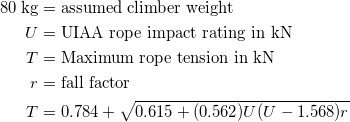
Right now, I don't know of any available calculators that give "correct" answers, meaning the answers using the basic spring model for a rope. Here is a "correct" equation, easily inserted into a spreadsheet or just implemented with a scientific calculator:
For a derivation, have a look at 4sport.ua/_upl/2/1404/Stand…. Please read the caveats about applicability while you're at it though. Here is a link to an interactive graph of this equation. The fall factor is the x-axis, the maximum rope tension in kN is the y-axis. The U-slider allows the graph to be modified for UIAA impact ratings between 6 kN and 12 kN. desmos.com/calculator/2mwfx…
|
|
|
David Coley
·
Jun 18, 2016
·
UK
· Joined Oct 2013
· Points: 70
rgold,
is there a problem with that formula, in that, it assumes the tension is equal both sides of the top runner? I note he says "The peak load on the top piece is conventionally calculated to be (5/3)T, which accounts for a frictional force over the top carabiner equal to 1/3 of the rope tension T on the leader’s side."
But if this is done, don't we need to recalculate T on the climber's side? As far as I can see that model only works for FF=2. Due to the friction at the top piece, the T on the climber's side will be greater than the model suggests.
|
|
|
rgold
·
Jun 18, 2016
·
Poughkeepsie, NY
· Joined Feb 2008
· Points: 526
The "he" you mention in the standard equation paper is me by the way.
You are correct that the formula treats the rope as a single entity in order to compute rope tension, which is found by determining the amount of maximum elongation involved. Then if you want to estimate the maximum load to the top carabiner you take 5/3 of that, accounting for friction. But even as a model of a single section of climbing rope, the standard equation is a crude first approximation. The problem, as described in bigel-labs.de/3.Physik/Rope…, is
With the harmonic oscillator model it´s in general not possible to fit the impact force given by the manufacturer together with the dynamic elongation. Whenever you find a perfect value for the modulus of elasticity to fit the maximum impact force, the dynamic elongation does not fit well. If the dynamic elongation is well-described the impact force is wrong.
In any case, modeling as just a single uniform entity is obviously) not right. One ought to consider how much elongation occurs for each section of rope between carabiners, as these elongations, being the result of forces reduced by friction, will not be the same. As soon as you do this, you get not one but a system of differential equations, so no longer a formula for the answer, but rather an iterative procedure that converges (under the right circumstances).
The result is a more accurate model, but one that can't easily be implemented with a scientific calculator. Actually, it could be done relatively easily for the situation in which there is but a single protection piece and so a system of just two differential equations to solve, but I've never bothered to work that out, since there are considerably more substantial efforts already in the literature.
The CAI has developed such a systems model, one that also incorporates the damping effects present in actual ropes. personal.strath.ac.uk/andre…, subsequently amplified by an analysis of the dynamics of belay devices, sciencedirect.com/science/a…;pid=1-s2.0-S1877705810004066-main.pdf. And there are several others out there as well, for example google.com/url?sa=t&rct=j&q=&esrc=s&source=web&cd=15&ved=0ahUKEwjatt7z47HNAhWJQiYKHTdVBHAQFghmMA4&url=http%3A%2F%2Ftheuiaa.org%2Fupload_area%2Ffiles%2F1%2Fsdarticle.pdf&usg=AFQjCNHnHhhhz8rPAw4sSCAAyqNXp5c0lA&sig2=SVrnUbTUEKmcRuTmlymsNQ.
Some of these models use techniques from materials science used to model viscoelastic deformation by using combinations of damped springs in parallel and series to better model both low and high load behavior. Even for a single section of rope, the result is a third-order non-linear equation that requires computer approximation methods. See for example personal.strath.ac.uk/andre…. A work that results in some analytic formulas for maximum elongation is at google.com/url?sa=t&rct=j&q=&esrc=s&source=web&cd=13&ved=0ahUKEwi394LV5LHNAhWE4SYKHXn3C7Y4ChAWCC8wAg&url=http%3A%2F%2Fkristinandjerry.name%2Fcmru%2Frescue_info%2FTechnical%2520Rescue%2520Research%2FViscoelastic%2520Theory%2520Of%2520Climbing%2520Ropes%2520-%2520Leuthausser.pdf&usg=AFQjCNGOl6pLNCuSEPCEXi631ZJWcvbrdg&sig2=Nj3j6xlVUWu9-a0hsR0F8g&bvm=bv.124817099,d.eWE.
A philosophical problem with the viscoelastic models is that they abandon any physical explanation for the observed phenomenon and just try to jigger together some damped oscillator components and then determine parameters that make the whole mess fit the observed behavior of ropes. (I'm obviously displaying a certain type of bias here of no interest to engineers.)
|
|
|
David Coley
·
Jun 19, 2016
·
UK
· Joined Oct 2013
· Points: 70
rgold wrote:The "he" you mention in the standard equation paper is me by the way. Sorry, didn't spot that!
If anyone can give me the equations simply presented I'm happy to put them in a spreadsheet and distribute.
From my angle this isn't really about trying to predict the exact force in a real fall. As I can't see this being useful as you would have to know the details of the fall, which I can only see you having after the event. And there are two many variables, like the grip of the belayer, the leader bouncing down the face etc. It is about education, i.e. explaining the issues / variables and their potential impact.
So, a model that gave:
FF
impact on climber, top piece, belayer
rope stretch
under the assumptions of
friction at top piece
length of fall
length of rope out
rope type
friction from the rock/gear on the belayer side - I guess this comes down to adding one more piece, or increasing the "friction" at the top piece.
And ignored
whether the belayer moves
the belly device
would be fantastic
|

 Continue with onX Maps
 Sign in with Facebook