
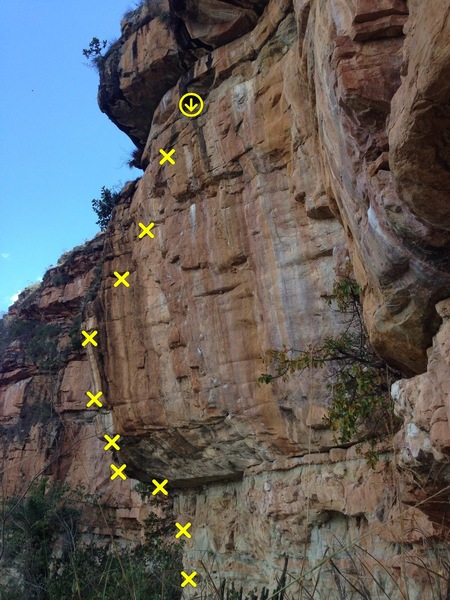
Located in the Chicamocha Canyon, one of the largest in the world, with 108 thousand hectares, formed 46 million years ago and covered in ancient times by a lake that allowed the formation of caves and incredible cliffs. La Mojarra climbing park extends for a kilometer and a half in the hearth of the canyon. The orange compact sandstone has more than 200 routes in rating from 5.7 to 5.14 and some projects.
All routes have been protected with high security criteria. In the morning, sunny conditions are hard, but after 12:00 soft conditions with the rock completely in the shadow and the temperature decreasing gives you the chance to enjoy perfect climbing, in beautiful and aerial scenery. The whole canyon continues with an infinite bolting possibility remaining.
The park was discovered 17 years ago by Juan Carlos Poveda, Juan Carlos Santander, Alejandro Navas, and Fabian Carreño, who began with the protection of the routes in 1999. Ricardo Cancelado, Juan Sebastian Ragua, and some other climbers from Bogota keep with the development of the climbing area this last year. The crag is in the hands of the non-profit Fundación Rocas de la Mojarra: https://www.fundacionrocasdelamojarra.org/
The accessibility of the place is very comfortable, is about 40 miles from the city of Bucaramanga at Mesa de Los Santos, department of Santander. Just 50 meters from the entrance to the park is Refugio la Roca (website) a very nice refugio for climbers, located on the top of the cliff. The owners are a Colombia couple, both of them climbers and the ones bolting most of the routes for the last 4 years. They have a very update guidebook, equipment rental, and a store where you can find basic equipment, resoling service and a very peaceful and quiet environment for climbers.
The weather is good all year and varies very little. The forecast on this website is not right.
The area named "La Mojarra Salvaje" is listed here as zones 19, 20, and 21.
For a full set of topos, go to https://www.fundacionrocasdelamojarra.org/blank-1. Keep in mind they are slightly outdated. Zone 8 was added later and everything was renumbered, so the topo numbering is off by one from 8 onward. For the topo of zone 8, see this image.
For the easiest routes at the crag, go to Zone 10 and look for these two routes: Verticualidad and Aracnoides.
In terms of hazards, look out for wasps and bees. People are removing the hives and nests constantly, but be on the lookout. Inspect the routes from the ground and as you climb; the darker more recessed spots can hide wasp nests especially. The bees are not your standard variety: mostly black body and much smaller, so easily confused with flies. They have ball-shaped hives the size of a tennis ball.
From the trail that starts at the Refugio, you can also access two more areas:
If you want to branch out a bit, check out the neighboring crags in the canyon:
Macaguato - Cañon del Chicamocha - multipitch routes
La Peña
From Bucaramanga, take the bus route to Piedecuesta. It's about 15 km. Being there search bus station Flota Cachira and take the bus route to La Mesa de los Santos and going down in Vereda la Mojarra, which take from 45 to 60 minutes. In the area is possible to do camping or take a bed and food, breakfast, lunch, dinner, in several hostels in the area. The price of bus route is approximately 4 USD dollars.
Alternatively, rent a car at the airport in Bucaramanga (directly with Localiza or through alkilautos.com). Two hours of driving gets you to the crag. The urban areas are rather packed with scooters and motorcycles so it can get relatively hectic, so drive gently and predictably and you should be fine.
Currently, the only direct flights to Bucaramanga from outside Colombia are from Florida and Panama City (check the map at https://www.flightsfrom.com/explorer/BGA). Mainly, it's connected with various cities throughout Colombia with many daily flights provides by multiple airlines.

 Continue with onX Maps
 Sign in with Facebook




Denver
If you are attempting to reach the area drive up the mesa and follow the main road past the cable car for the chicamocha park heading towards Los Santos (the town). Before you reach the town by a couple miles you will see on a hill directly off the road on the left, the sign for and the hostel itself (refugio de la roca). You can park here or just past the hostel at the stand on the left. This is where you can access the crag. At the hostel they have a guide book with pictures that they loan out.
If you are not staying at the hostel it is much faster to access the routes from piedecuesta or bucaramanga, as you can avoid the tedious drive through the canyon and the two tolls. Jun 12, 2015
La Mojarra - review and videos bestclimbingplaces.com/list…
blog.eddiebauer.com/2015/08… Oct 16, 2016
In order to climb they make you do a climbing test, pay a daily entrance fee (10,000 COP, less if you stay at local hostals) and sign legal disclaimers. There's also a complicated ticketing system. Honestly it's a complete hassle.
The crag doesn't "open" until mid morning meaning you can't go for a dawn raid and avoid the heat.
The published grades are not accurate. There are only a handful of beginner/warm up routes. Head to sector 10 for these. A couple of them are highly polished.
All other routes are overhanging. If steep climbing is your thing then this is the crag for you.
Condition of the routes is pretty good. I only found a couple of spinning bolts.
There's a few good trad lines but it didn't seem like anyone bothers climbing them. Bring small cams.
Most routes need less than 10 quickdraws. Bring some extenders for the overhangs.
Hostal Juan Palitos is cheaper and in my opinion much nicer than the refugio. Jul 8, 2018
I will be down in Columbia starting the first week of Nov. 2018, and my girlfriend and I are planning to rent gear and do some climbing in the Chicamocha Canyon area starting Nov. 8-10 (give or take). Does anyone want to meet up? Can anyone give me beta on specific areas, as well?
Feel free to email me at:
nick.carpenter667@gmail.com
Any help is good help!
Much appreciated in advance!
Cheers,
Nick Oct 29, 2018
1. There is a fee to climb here. If you stay at the Refugio la Roca, the fee is waived. (In 2018, it's 10,000 COP, or about $3.00.)
2. There is a small entrance station where your fee is collected, and you must pass through this to access the main cliff areas. If you are staying at the Refugio, ask for a "climbing ticket" at the front desk, then present this to the person at the entrance station so your fee is waived. After climbing here a few days, everyone at the Refugio knows you, and knows you're staying at the Regugio, but you STILL must have this ticket to get your fee waived.
3. You will be asked to sign a register each day you climb here. Even the owner of the property signs in, so they seem pretty serious about it.
4. If this is your first time, you will be asked to complete a waiver. It takes about 1 minute, and is similar to waivers you see at gyms. I assume this is for liability to protect the property owner. Once completed, we never had to revisit this. You need your passport number for this, so be sure to bring it to the cliff for your first visit.
5. If this is your first time, you will also be asked to demonstrate your anchor change-overs. We were not asked to do this, as we clearly knew what we were doing. Many people that climb here do not, so perhaps this is for the best?
6. The entrance station is locked until somebody from the Refugio goes down and opens it; times vary. Several times we just hopped the fence and signed the logbook on our way out. If you ask at the Refugio, perhaps they will open it early? Just talk to Ricardo, the owner, and figure something out; he's a climber and will accommodate. Nobody seemed bothered by us hopping the fence (and taking care of biz on the way out).
7. There is a guidebook, which is simply a collection of thick, index-sized cards printed in color with the sectors topos. These cards are small and crammed with info, and even with my glasses I could barely read them. I was wishing I had printed (on large paper) the sector topos from their web site in advance. You can purchase the guidebook at the Refugio. Be warned -- the purchased guide is more up-to-date than the online info.
8. There are 18 sectors on the main cliff, and this is where most people climb. There are additional sectors above the camping, and I was very unimpressed by these -- very short, junky rock, and bee hives everywhere. There are also additional sectors beyond sector 18 accessed from a via feratta; we examined these carefully and there are some cool-looking routes, although nobody climbs here, so you won't find any chalk.
9. Did I mention the bee hives? There were "death star" hives littering the cliff, and paper wasps nest everywhere. On several routes, I lowered a rope for my stick clip and cleared the [smaller] paper wasp nest above me. I wouldn't dare touch the death stars. Often the nests are off to the side, and the insects don't seem very aggressive. But I did get stung. Might want to bring medications if you have a sensitivity to stings. We definitely stayed off some routes due to the nests. We were told that the Refugio clears these from time to time. I don't envy that job. (We had the similar issues at Machetá, so we were used to it.) Nov 25, 2018
Where to stay: There are a few nearby hostels where you can either pay for a bed or to camp, but the only real option is Refugio la Roca. It is the closest and by far the most popular place to stay. A high percentage of its clientele are climbers, so it is the spot to go if you’re looking for a partner or someone to hang out with. Not to mention, El Refugio owns the access rights to the climbing, so your entrance is free only if you stay there!
The Climbing - In a word, excellent. The rock is high quality, heavily featured sandstone. There is a mix of styles, but most of the routes are slightly to very overhung, with a lot of explosive bouldery moves. Super fun to climb. The bolting has all been done to a high professional quality, and due to the dry desert conditions, you don’t really have to worry much about rust. All bolts are stainless or titanium glue-ins.
How to arrive - From Bucaramunga, take a bus or cab to the town of Pidecuesta. If you are coming from the airport, I suggest taking a cab to Pidecuesta as the buses to arrive are a mess (the cost from the airport to Pidecusta is 30,000-35,000COP). From there you can take a bus towards Los Santos (they leave every 30 min or so). From Piedecuesta it will take 1.5-2 hours to arrive at the Refugio.
For a full guide on the climbing see: thewanderingclimber.com/spo… Feb 23, 2019
San Juan metro area Puerto…
Make sure to check the comments from previous years for other details.
Here in July, the crag goes into the shade around noon to 1pm depending on the section of rock. The weather is perfect afterward: comfortable short sleeve temperatures and a nice breeze most of the time. However, biting sand flies will annoy you on days when there's no breeze. Also make sure to bring a layer of clothing in case you get chilly.
The easy way to get to the crag is to take one of the many daily flights from Bogotá to Bucaramanga and rent a car at the airport (directly with Localiza or through alkilautos.com). Two hours of driving gets you to the crag. Currently, the only direct flights to Bucaramanga from outside Colombia are from Fort Lauderdale and Panama City (see flightsfrom.com/explorer/BGA).
If checking in at Colombian airports, put all your bulky climbing gear in your checked luggage. At security in Bogotá, they were just about set on confiscating my Rock Rings hangboard, and looked very concerned at the Gri Gri and the Ohm. They seem concerned about heavy blunt objects. Jul 5, 2022
San Juan metro area Puerto…
San Juan metro area Puerto…
Bucaramanga
We offer detailed information on the best bouldering and sport climbing areas, as well as accommodation options including hostels, lodges, and camping sites. Need help getting around? We've got you covered with tips on transportation and how to reach each climbing sector.
We also organize guided excursions for all levels, taking you to top bouldering zones and thrilling sport climbing sectors. Plus, we can introduce you to the best indoor climbing gyms in Bucaramanga to keep your skills sharp.
Ready for your next adventure? Contact us at crashpadcc@gmail.com or on Instagram @crash_path Aug 11, 2024
Bucaramanga
We offer detailed information on the best bouldering and sport climbing areas, as well as accommodation options including hostels, lodges, and camping sites. Need help getting around? We've got you covered with tips on transportation and how to reach each climbing sector.
We also organize guided excursions for all levels, taking you to top bouldering zones and thrilling sport climbing sectors. Plus, we can introduce you to the best indoor climbing gyms in Bucaramanga to keep your skills sharp.
Ready for your next adventure? Contact us at crashpadcc@gmail.com or on Instagram @crash_path Aug 11, 2024