
 Continue with onX Maps
 Sign in with Facebook






Anchor Question



|
Hey guys new trad climber here. I was trained on the cordallete for equalizing protection. Starting to learn about equalizing with rope to add it to my tool kit, as well as attempting to learn to think in climbing. I have seen online that you shouldn't belay in guide mode from a rope equalized anchor. I created this and in my opinion it meets all the SERENE/EARNEST, anchor properties. What are the collective thoughts on something like this? I know the angle isn't great i was working with what I could in my college dorm. Please comment if I need to take a different picture or explain something in it. 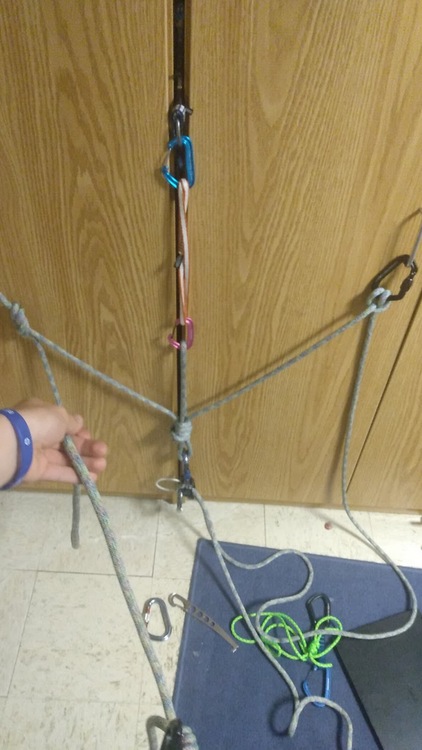 |
|
|
Bailey Nicholsonwrote: I’m curious to know why. I would not hesitate to use a rope anchor to bring my partner up in guide mode if circumstances worked out for that.
Looks ok to me for belay from above in guide mode if the center piece is bomber. Except the belayer could get tossed around if they weight the left piece and it pops, shock loading the middle piece - Ug. MP user RGold sometimes posts a picture of a rope anchor which remedies the above. You’ll appreciate seeing that. Limited on time to find it right now. Also, if you haven’t, think through how you would deal with being tied into the anchor if you were not swapping leads. Last, if multi-pitch is your passion, get well versed in belaying off the harness. Guide mode is no bueno in some circumstances. |
|
|
Here is the rgold anchor. Elegant, adaptable, and totally worth mastering. 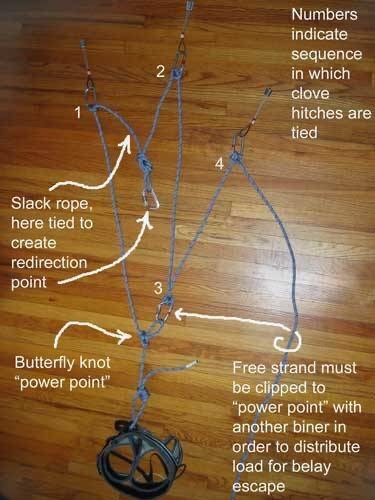 |
|
|
Andy Wiesnerwrote: Thank you, will attempt to recreate! |
|
|
Bill Lawrywrote: That is just what I have heard, never really understood it. Its defiantly good to know both, I am familiar with harness belays. I also think people underutilize the munter in some situations. I think a fundamental problem with rope anchors is the difficulty in switching if not swapping leads. I found this old MP thread which has solid options. You can also utilize some interesting techniques involving a european style lead belay off the anchors. |
|
|
Bailey Nicholsonwrote: Using the climbing rope to replicate a “webolette” style (single strand, double center strand, single strand) anchor has been utilized for years and works well. I have used it on occasion. It especially works if the gear placements are far apart and your cordalette won’t reach and you are short on other sling material to extend it. Using the rope as the anchor material has its pros and cons (as do all systems). As always, what system you use is a judgment call on your part. The rope works great as you mentioned for swinging/swapping leads; not so good for block leading. Works great for single pitch, not so much for multi-pitch if next pitch is a long one and you need full length of rope. Some climbers reject the idea of using the rope in the anchor because it makes escaping the belay more difficult; true, but that scenario is rare, but if encountered can be worked around. As you mentioned, the outside angle is a bit large (ideally should be smaller) so we don’t need to discuss this further. You are clipped into the anchor at one one point (left side). It would be better to clip into the MPoint. You could do that by making the length of rope between you and the left piece longer so as to allow you to clove hitch into the MPoint. The extra length of rope would also give you some ability to adjust your tie in length; right now your photo shows your ability to move around is limited. The left anchor connection looks like a figure 8 knot. A clove hitch connection, like you did on the right side would allow you to fine tune the tension on the left anchor arm (if needed). Having the ability to lengthen (or shorten) the left and right anchor arms also gives you some ability to shift the MPoint’s location for this pitch or the next one without untying or disconnecting from the anchor. In this form of a 3 piece/pro set up, testing has shown the center piece takes more than the ideal/theoretical 1/3 of the load. The fact that this set up has 2 strands in the center would increase that percentage even more. Testing has also shown that the shortest arm of your anchor will take more of the load. Is the sling on the center piece necessary? Would running the center strands all the way to the pro improve the load distribution? Right now, it would appear that the center pro is taking a very large part of the load. As I said, I have used this configuration when I thought it best matched the anchor/climbing scenario. Knowing several/many anchor rigging systems and using the one most appropriate for the scenario presented is the way to go. Good luck with your further journey. |
|
|
Bailey Nicholsonwrote: Maybe they assume the master point ends up too low for guide mode to be comfortable. My other guess is escaping the belay, but this seems more an argument against rope anchors given guide mode belay than an argument against guide mode belay given rope anchors. |
|
|
What you posted is super good enough. There are many variables that can influence what the "best" set up in any scenario is. Practice, learn, and get solid on as many techniques as you can. |
|
|
Bill Lawrywrote: When is guide mode “no bueno”? |
|
|
Tradibanwrote: When the lay of the rig holds the ATC Guide against the rock in a way that could keep it from orienting for solid braking. Topping out on a dome with a pocked surface comes to mind. But other cases too. Personally, I prefer no ATC contact with the rock. But, like everything, there are probably degrees. Perhaps less of an issue is if the circumstances put the device where it is hard for the belayer to operate. |
|
|
Tradibanwrote: When you want to lower a fallen follower and haven’t mastered how to do that safely. |
|
|
Bill Lawrywrote: This is not hypothetical, I know a case when a guide had his plaquette jam under load against a little corner, and he had to rig a 3:1 hoist to unload the plate so that the second, who had swung out into space, could be lowered. It took a lot of time and effort and could have been a full-blown epic for someone who didn't have the additional knowledge and skills to pull this off. In all these situations, it is better to have the belayer seated (ideally) or standing at the lip with a long strand back to the anchor and some kind of harness belay. I say "some kind" because the best way to manage this to have the belay plate clipped to the tie-in loop rather than the harness belay loop and the anchor strand tensioned so that any load is transmitted straight to the anchor. |
|
|
If one has extended to the lip it is possible to redirect into the rope extension. |
|
|
Andy Wiesnerwrote: You best start practicing then. Regardless lowering should be avoided as it can easily be miscommunicated. I tell my followers “There will be no lowering, so figure it out”. |
|
|
Tradibanwrote: Ha ha. We have adopted similar as a mantra - though that was when climbing with two concurrently climbing followers. Later, we practiced lowering even when two followers are involved. Still, just good for everyone to know the day will go much more smoothly if no one needs to lower. Edit to add: I appreciated are RGolds thoughts above as always. |
|
|
Hey all OP back here. I went over my 3 mp comments a day oops. I recreated Rgolds anchor and really like it. I have a couple of thoughts and questions after seeing how the thread has evolved. https://imgur.com/a/nb4GONk First off on the Rgold diagram can you talk about the clip thread to master point? Is this just talking about don't belay off the single strand and attach to the master point or is it something more? I obviously would attach both myself and the plate to the anchor. My skills at belay escapes are still developing, especially with this rope anchor setup. To answer Previous questions the sling was only there because of the weirdness of trying to build an anchor in a dorm room, and then adjusting it as a result of my wardrobe shifting. In the future I would definitely run the rope up to the anchor. I would also like some elaboration from Rgold on the harness belay. I am a little bit confused on the setup and benefits, especially with transferring load to the anchors. I am somewhat familiar with a method of a redirect of an ATC style device for similar situations. Also you can use a hip belay depending on how much of a crafty rope trick you want to pull out. Alpine Savvy has a really cool article of how you can use this (one of my local old timers (been climbing at that crag since the 70s) uses a modified one where he adds a carabiner that works well.) Just to reiterate everyone looking to use guide mode needs to know various methods to lower!! Nut tool and the LSD are two of my favorite underutilized methods in my opinion. As always let me know if any of this is wrong or if more clarification is needed. |
|
|
Bailey Nicholsonwrote: I prefer to clip the belay device to the rope loop rather than to the rigging carabiner, but I'm not sure it makes that much difference
I'm not sure what you mean. The diagram does say "free strand must be clipped to powerpoint..." That's only for a belay escape. The reason is that the backside strand coming off the anchor typically has to be loaded (usually via a Munter mule) as part of the escape process. In the diagram, that strand is "free" and only connected to one anchor piece. Clipping it back to the power point means any load to that strand is distributed to all the anchor pieces.
I suggested the harness belay for situations when the plaquette is really suboptimal for the reasons I mentioned above. The standard harness belay would have the device clipped to the belay loop on the harness, the version I'm speaking of clips the device to the rope tie-in loop. Assuming the belayer has properly set up the tie-in so that there is no slack in it, the load to the belay device goes straight to the anchor rather than twisting the harness and the belayer's body. |
|
|
Step 1: stop worrying about equalization. |
|
|
JaredGwrote: I wouldn't put it that way. Well, if the anchor is two modern bolts, it doesn't really matter how you're connected to them. But for trad anchors, I think load distribution can matter. So if "stop worrying about equalization" means "don't bother thinking about how the load will be distributed," I don't think that's the best approach. If it means, "equalization is not attainable in practice so don't go nuts trying to make it happen," then fine. Some of the testing I've seen suggests, that as a rule of thumb, one piece in an "equalized" anchor is going to end up with at least half the total load no matter what. And then some anchor rigging gives away the game at the very outset by employing configurations that aren't even theoretically equalized. This is fine if the pieces are all good, but the climber should know how the rigging is going to distribute in theory, because there may be configuration choices that are not equivalent in view of the relative strength of the individual pieces. This does not and should not have to consume extra time. |
|
|
I d4efinately think the idea of two modern bolts not needing to be equalized is true. Have you all seen some of the seen some of the european anchors especially the fixe anchor. Might you be able to do another one of your awesome diagrams. I am still a little confused about the setup you are describing with the tie in points, I am genuinely curious and sorry to be the bother. Like I said I feel solid on the alternative harness belay and a hip belay for the situations you may run into. I also appreciate you talking about the theoretical limits of equalization, I have definitely seen climbers run into that problem of trying to overequalize marginal pieces. |
|
|
Andy Wiesnerwrote: Best anchor. Will even use it on 2-bolts often enough. Regarding lowering: imo vergo is the superior single strand guide belay device. I've lowered my follower tons of times with no issue, rope flows through easier than a plaquette, easy to orients so that any failure modes caused by contact with rock are avoided |


